GST · 1 September 2026
What turnover thresholds make GST registration mandatory in 2026?
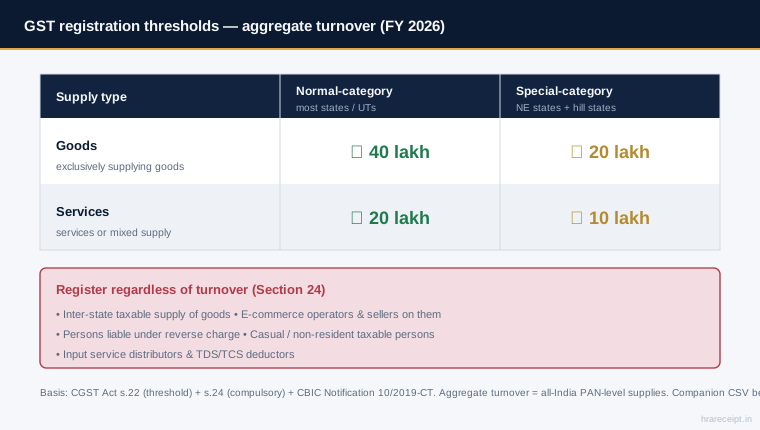
GST registration turns mandatory at a turnover line that changes with what you supply and where. Under Section 22 of the CGST Act the threshold is ₹40 lakh for a supplier of goods only in normal-category states (₹20 lakh in special-category states), and ₹20 lakh for services or mixed supply (₹10 lakh in special-category states). Separately, Section 24 lists persons who must register regardless of turnover, from the first rupee: inter-state goods suppliers, e-commerce operators and the sellers on them, reverse-charge-liable persons, and casual or non-resident taxable persons. So the threshold question has two parts: are you over the turnover limit for your supply type and state, and do you fall into any Section 24 category that overrides it?
By Mrs. Swapna Patel
Published on 1 September 2026
Last modified on 1 September 2026
By Mrs. Swapna Patel
Published 1 September 2026
Updated 1 September 2026
In this section
Answers
- What turnover thresholds make GST registration mandatory in 2026?
- What does a ₹1 revenue stamp on a rent receipt actually prove?
- GSTR-1, GSTR-2B and GSTR-3B: Which GST Return Is Which, and How?
- What Is the Time of Supply Under GST, and When Does Tax Become Due?
- What Is the Value of Supply Under Section 15 of the CGST Act?
- What Are the GST Rate Slabs in India After the GST 2.0 Reform?
- Exempt vs Nil-Rated vs Zero-Rated Supply: What Is the Difference?
- Composite vs Mixed Supply Under Section 8: Which GST Rate Applies?
- What Is TCS Under GST? The Tax E-Commerce Platforms Collect
- Electronic Credit Ledger vs Cash Ledger: What Is the Difference?
GST registration becomes compulsory only once your sales cross ₹20 lakh.
Turnover is one trigger; Section 24 of the CGST Act[2] forces registration from the first rupee for inter-state goods suppliers, e-commerce sellers, and reverse-charge-liable persons, whatever their turnover.
What turnover makes GST registration mandatory in 2026?
Short answer
Under Section 22 of the CGST Act[1], a goods-only supplier must register above ₹40 lakh aggregate turnover in normal-category states (₹20 lakh in special-category states); a supplier of services or a mixed supply must register above ₹20 lakh (₹10 lakh in special-category states).
Aggregate turnover here is the all-India, PAN-level total of taxable plus exempt supplies, not the turnover of a single branch. The threshold that applies to you turns on two things: whether you supply goods only or services, and whether you operate in a normal or a special-category state.
| Type of supplier | Normal-category states | Special-category states |
|---|---|---|
| Goods only | ₹40 lakh | ₹20 lakh |
| Services, or mixed supply | ₹20 lakh | ₹10 lakh |
Section 22 mandatory-registration thresholds. Source: Section 22, CGST Act 2017[1] and Notification 10/2019-Central Tax[3], which set the ₹40 lakh goods limit under Section 23(2). Ten states and UTs stayed at ₹20 lakh, so confirm your own state's adopted limit before relying on a row.
What is a special-category state, and why is its threshold lower?
Short answer
Special-category states carry the lower thresholds (₹20 lakh for goods, ₹10 lakh for services) under Section 22[1]; it is the constitutional grouping that includes the North-Eastern states and certain hill states.
- The grouping covers the North-Eastern states and a few hill states; the exact list changes, so confirm your state with CBIC[4].
- For a goods-only supplier in such a state the line is ₹20 lakh, not ₹40 lakh.
- For services or a mixed supply the line is ₹10 lakh, not ₹20 lakh.
- Why it matters: a small trader in a special-category state crosses the registration line at half the turnover a trader in a normal state does.
Who must register regardless of turnover under Section 24?
Short answer
Section 24 of the CGST Act[2] forces registration from the first rupee, whatever the turnover, for a defined list of persons; the threshold does not apply to them at all.
- Anyone making an inter-state taxable supply of goods must register, even at ₹1 of turnover.
- E-commerce operators, and the sellers who supply through them, must register.
- Persons liable to pay tax under reverse charge must register.
- Casual taxable persons, non-resident taxable persons, input service distributors, and TDS/TCS deductors must register.
- Why it matters: many first-year businesses register because of Section 24, selling to another state or listing on a marketplace, long before their turnover would ever have required it.
How do the turnover test and the Section 24 override fit together?
Short answer
The two run in parallel: you must register if you cross the Section 22[1] turnover line for your supply type and state, OR if you fall into any Section 24[2] category, whichever bites first.
The turnover figure the test is measured against is aggregate turnover, defined at PAN level across India. Because it folds in exempt, export, and inter-state supplies, a business tracking only its taxable sales can cross the line without realising it.
- Step one: is my aggregate turnover over the limit for my supply type and state? If yes, register.
- Step two: do I fall into any Section 24 category (inter-state goods, e-commerce, reverse charge, casual or non-resident)? If yes, register regardless of turnover.
- For how the turnover number itself is built, see aggregate turnover (AATO) under Section 2(6).
- Once registered, issue a compliant pakka bill on every taxable supply; below the threshold and outside Section 24, a bill of supply is the correct document.
References
- 1.Section 22, CGST Act 2017 (persons liable to register) — CBIC — The aggregate-turnover thresholds for mandatory registration, including the ₹20 lakh / ₹10 lakh special-category-state limits and the third-proviso power to enhance the goods limit to ₹40 lakh.
- 2.Section 24, CGST Act 2017 (compulsory registration) — CBIC — Persons who must register regardless of turnover: inter-state, e-commerce, reverse-charge, casual and non-resident taxable persons.
- 3.Notification 10/2019-Central Tax (₹40 lakh goods threshold) — GST Council — The ₹40 lakh registration exemption for suppliers engaged exclusively in goods, issued under Section 23(2); ten states and UTs stayed at ₹20 lakh.
- 4.GST — Central Board of Indirect Taxes and Customs (CBIC) — Official CBIC GST portal; confirm the special-category-state list and your state's adopted goods threshold.
References & related
Primary sources
- Section 22, CGST Act 2017 (persons liable to register) — CBICThe aggregate-turnover thresholds for mandatory registration, including the ₹20 lakh / ₹10 lakh special-category-state limits and the third-proviso power to enhance the goods limit to ₹40 lakh.
- Section 24, CGST Act 2017 (compulsory registration) — CBICPersons who must register regardless of turnover: inter-state, e-commerce, reverse-charge, casual and non-resident taxable persons.
- Notification 10/2019-Central Tax (₹40 lakh goods threshold) — GST CouncilThe ₹40 lakh registration exemption for suppliers engaged exclusively in goods, issued under Section 23(2); ten states and UTs stayed at ₹20 lakh.
- GST — Central Board of Indirect Taxes and Customs (CBIC)Official CBIC GST portal; confirm the special-category-state list and your state's adopted goods threshold.