Privacy-first · no signup
Payment Receipt Generator India
Issue an audit-ready payment receipt for services, fees, deposits, or advances — with UTR or cheque reference. Live preview free; ₹5 for the final PDF. Your data never leaves your browser.
— No app to install · no sign-up · your document data stays in your browser.
In this section
Part of: GST & Business Billing →
Guides for this document
Related generators
What this generates
- General-purpose payment receipt
- Payer + payee + amount in figures and words
- Mode of payment (cash / cheque / UPI / NEFT)
- Optional purpose / reference line
- Section 269ST aware — flags receipts > ₹2 lakh in a day
Primary sources
Receipt Details
Receipt number and date — both pre-filled.
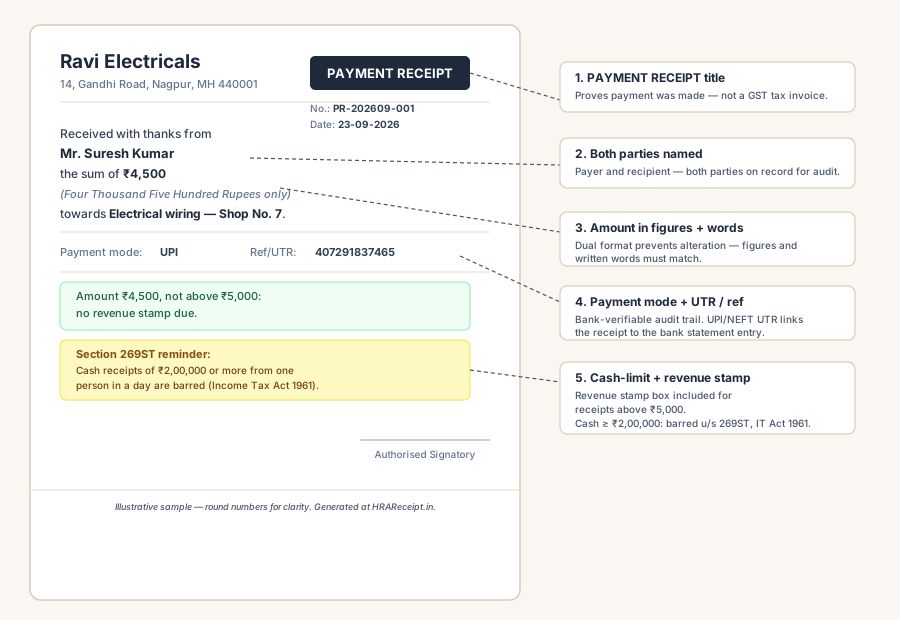
How to generate a payment receipt
- Enter the payer's name and the recipient's name, address, and GSTIN (if any). PAN is required for transactions above ₹2,00,000 (Rule 159, formerly 114B).
- Enter the receipt date, amount, and purpose. Choose full settlement, part-payment, or advance.
- Select the payment mode — UPI, NEFT/IMPS/RTGS, cheque, or cash. Enter the UTR or UPI transaction ID for digital payments. Revenue stamp box included for receipts above ₹5,000.
- Proofread the live on-page preview — amount, parties, date, and reference. Pay ₹5 for the final, ready-to-issue PDF. No signup.
Your receipt data is processed entirely in your browser — names, amounts, PAN, and UTR numbers never reach our servers. We do not store, log, or share your document data.
Cash receipts of ₹2,00,000 or more from a single person in a day are barred under Section 269ST of the Income Tax Act, 1961 — a 100% penalty applies under Section 271DA. Read the full explainer: Section 269ST — cash transaction limit explained
Also: Invoice vs receipt vs quotation — what's the difference?
What's included in every receipt
Payer and recipient
Full names, address, and GSTIN (if any) — both parties recorded for audit.
Payment mode
UPI, NEFT/IMPS/RTGS, cheque, or cash — with UTR or cheque number for bank reconciliation.
Invoice reference
Link the receipt to an invoice number — creates a complete supply-and-payment audit trail.
Part-payment and advance
Full settlement, part-payment (with signed balance), or advance for a future period.
Revenue-stamp guidance
Revenue stamp box included for receipts above ₹5,000.
Privacy-first
All data stays in your browser — names, PAN, UTR, and amounts never reach our servers.
Full payment, part-payment, and advance — explained
Choose the right receipt type for your transaction.
Full payment
Final settlementThe payer settles the entire amount due in one payment. The receipt records the total and closes the transaction.
Part-payment
Balance outstandingThe payer pays a portion of the total due. The receipt shows the total due, the amount paid now, and the signed balance remaining — keeping both parties aligned on what is still owed.
Advance payment
Pre-paymentPayment made before the goods or services are delivered. The receipt records the period or purpose covered, so both parties have a documentary anchor for future settlement.
This is general information, not legal or tax advice. Consult a qualified professional for your specific situation.
Are you a GST-registered business issuing a tax invoice?
A payment receipt is not a GST tax invoice. Registered sellers must issue a Pakka Bill (tax invoice) at the time of supply under Section 31 of the CGST Act.
FAQ
Payment receipt: common questions
When do I issue a payment receipt versus an invoice?
Does the receipt include UTR for digital payments?
Do I need a revenue stamp on a receipt above Rs. 5,000?
Can the payment receipt cover an advance or part-payment?
Is this accepted for audit and reconciliation?
References
After you generate
- Audit-ready PDF with date, mode, and reference
- Section 269ST inline check flags risky cash totals
- Use the Section 269ST Checker tool to test compliance independently
First-timer questions
Do I need PAN on a cash receipt?
PAN is required for transactions above ₹2,00,000 (Rule 159, formerly 114B).
What about Section 269ST?
No person may receive ≥ ₹2 lakh in cash from one person, in one transaction, or for one event/occasion. Our generator warns at that limit; the Section 269ST Checker tool covers all three prongs.
Is this acceptable for ITR documentation?
Yes — the receipt format follows the standard documentary trail your AO expects. Keep the PDF + your bank trail (if non-cash) together.
Can I issue without a GSTIN?
Yes. Misc receipt is for non-GST transactions (loan repayment, personal services, refund acknowledgement). For GST sales use the Pakka Bill / Bill of Supply generators.
Last reviewed: 23 September 2026
For HR teams · Bulk plans
Generating multiple payment receipts for your team?
A bulk plan unlocks credits across all five generators (GST invoices, payment receipts, salary slips, rent receipts, kaccha bills). Plans start from Rs.499 → 100 credits on a 45-day wallet. Once you have a code, you can either generate one document at a time on any generator page, or upload an Excel of up to 500 rows on /corporate-bulk to get a ZIP of clean PDFs in one shot. Excel parses entirely in your browser; no row data reaches our servers.