Skip to content
HRAreceipt.in

100% Free — No Payment Required

Kaccha Bill Generator

Create an informal bill (कच्चा बिल) for any small transaction — shops, services, vendors, or daily use.

We never see what you make.

Free
Kaccha billNo payment · No watermark · No catch
In this section
Privacy Mode: Your data is processed locally in your browser and is never sent to our servers.
1
2
3
4

Bill Details

Pick a bill number and date — both pre-filled.
Reviewed by Mrs. Swapna Patel·Indirect tax editorial contributor (GST, tax invoice, CGST Rules)

Who Uses a Kaccha Bill?

🛒

Kirana & Grocery Stores

Quick bill for regular customers — list items, quantities, and total.

🔧

Plumbers & Electricians

Bill for materials + labour charges after a repair or installation job.

🍛

Dhabas & Food Stalls

Simple itemised bill for food orders and takeaways.

✂️

Tailors & Cobblers

Receipt for stitching, alterations, or repair charges.

📦

Small Vendors & Suppliers

Delivery bill for goods supplied to small businesses or households.

🏠

Household Help

Receipt for cooking, cleaning, or any informal domestic service.

Kaccha Bill vs. Pakka Bill

Know when to use which.

FeatureKaccha BillPakka Bill (GST Invoice)
Who uses itSmall shops, informal vendors, individualsGST-registered businesses
GST applicableNoYes — CGST, SGST/IGST
GSTIN requiredNoMandatory
Legal for tax auditFor small informal transactionsYes — full compliance
Cost to generateFree₹9 at HRAReceipt.in
Items listYesYes

Need a proper GST receipt? Generate a GST Invoice (Pakka Bill) →

When is a kaccha bill legal, and when must you stop?

A kaccha bill records a cash sale with no GSTIN and no tax charged. That is fine while you are an unregistered seller below the GST registration threshold. Once your turnover crosses the threshold, the law expects a pakka bill (GST tax invoice) instead, because a taxable sale needs a Section 31 invoice carrying the Rule 46 fields.

The registration thresholds that end kaccha-bill use

Under Section 22 of the CGST Act, registration is mandatory once aggregate turnover crosses these lines. The ₹40 lakh goods figure came in via CBIC Notification 10/2019-Central Tax and is state-opt-in, so confirm your own state's adopted limit.

Supply typeNormal statesSpecial-category states
Goods only₹40 lakh₹20 lakh
Services or mixed supply₹20 lakh₹10 lakh

For goods, the ₹40 lakh threshold (Notification 10/2019-Central Tax) does not extend to ten states that remain at ₹20 lakh: Arunachal Pradesh, Manipur, Meghalaya, Mizoram, Nagaland, Puducherry, Sikkim, Telangana, Tripura, and Uttarakhand. For services and mixed supply, the four states that keep the ₹10 lakh threshold are Manipur, Mizoram, Nagaland, and Tripura. Inter-state sellers and e-commerce sellers must register from the first rupee under Section 24 (goods; inter-state suppliers of services keep the ₹20 lakh threshold under Notification 10/2017-Integrated Tax). Thresholds are state- and year-variable; check the CBIC portal before you rely on a figure.

A worked kirana example

Take a kirana store in a normal-category state selling only goods. In its first year it turns over ₹14 lakh in cash, all recorded on kaccha bills. That is legal: it is below the ₹40 lakh goods threshold and unregistered, so no GST invoice is required. As footfall grows, turnover reaches ₹42 lakh. It has now crossed ₹40 lakh, so GST registration becomes mandatory: from that point the store must obtain a GSTIN and issue a pakka bill on taxable sales, not a kaccha slip. A registered seller who keeps handing out kaccha bills on taxable sales understates turnover and, at a GST audit, faces tax, interest, and a penalty.

The Section 269ST ₹2 lakh cash-receipt limit

A kaccha bill records a cash receipt, and cash has a separate hard ceiling that applies whether or not you are GST-registered. Section 269ST of the Income-tax Act bars any person from receiving ₹2 lakh or more in cash from one person in a day, against a single transaction, or for a single event. Breach it and Section 271DA levies a penalty equal to 100% of the amount, on the receiver of the cash, not the payer. So even a fully unregistered kirana seller cannot take ₹2 lakh or more in cash for one order or one customer's day of purchases without crossing this line. When a buyer refuses to pay by bank channel and a payment could approach ₹2 lakh, that is the risk to weigh. See the Section 269ST cash transaction limit explained and, if a buyer is refusing a GST invoice, what the buyer's rights are.

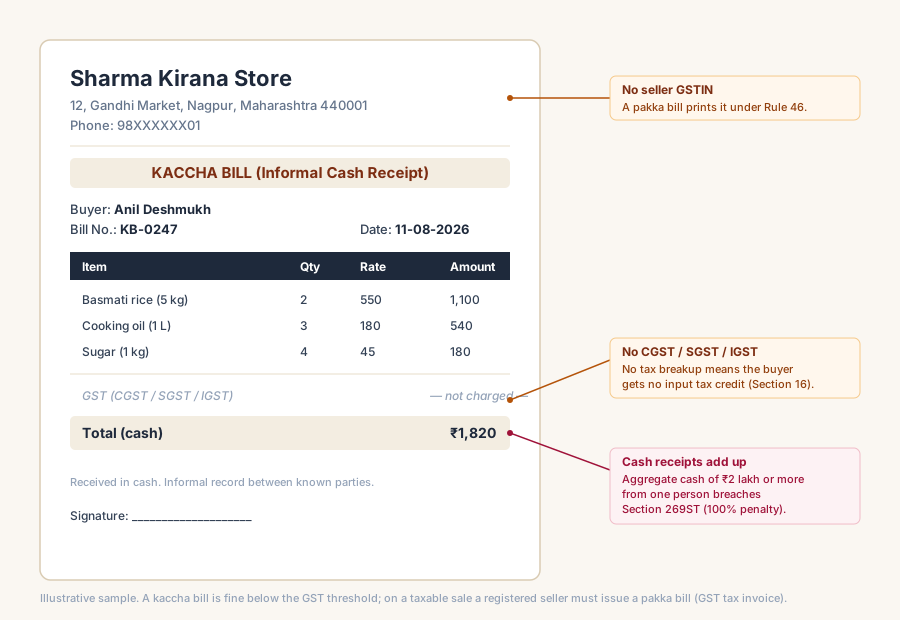
What a kaccha bill looks like, field by field

Annotated sample kaccha bill for a kirana store, with callouts marking the absent seller GSTIN, the absent CGST/SGST/IGST tax split that blocks the buyer's input tax credit under Section 16, and the aggregating cash total that a ₹2 lakh receipt would push over the Section 269ST limit.
A sample kaccha bill: shop and buyer details, item lines, and a cash total, but no GSTIN and no tax split. Those two gaps are exactly what a pakka bill adds.

Related guides

FAQ

Kaccha bill — common questions

What is a kaccha bill and when is it valid?
A kaccha bill (informal cash receipt) is a non-GST invoice traditionally used by small businesses and unregistered traders for cash transactions. It records the parties, amount, and date but does not claim GST and cannot be used for Input Tax Credit. For GST-registered sellers, a tax invoice (pakka bill) is the legal requirement; for unregistered sellers, a bill of supply under Rule 49 CGST Rules is the proper formal document.
Is the kaccha bill legally valid?
Yes for record-keeping and transactional acknowledgment between parties. It is NOT valid for GST Input Tax Credit, and NOT a substitute for a tax invoice if you are GST-registered. Buyers requiring "GST bills" need a tax invoice or bill of supply, not a kaccha bill. See our seller refuses GST invoice — buyer rights guide.
Why is the kaccha bill free?
Kaccha bill is a courtesy generator for very small businesses and individual sellers below GST registration thresholds who handle predominantly cash. We do not think a Rs. 9 charge belongs on this document. Other product types (rent receipt, salary slip, payment receipt, GST tax invoice) carry pricing because their compliance use cases warrant the engineering cost.
Should I voluntarily register for GST instead of issuing kaccha bills?
Voluntary registration makes sense if your B2B clients require Input Tax Credit, your input costs include significant GST you could otherwise recover, or you are approaching the Rs. 20 lakh registration threshold organically. Below the threshold, staying unregistered and issuing kaccha bills or bills of supply is usually fine for B2C and unregistered-buyer transactions.
What is the difference between a kaccha bill and a bill of supply?
A bill of supply is the formal Rule 49 CGST document required of registered composition-scheme sellers and registered sellers of exempt goods or services. A kaccha bill is the informal transactional acknowledgment used by unregistered sellers below the registration threshold. Bill of supply has formal legal status under CGST; kaccha bill is a transactional courtesy. The pakka bill form auto-detects whether to render as TAX INVOICE or BILL OF SUPPLY depending on whether you have entered a GSTIN.

References

After you generate

  • PDF downloads to your device — no copy on our servers
  • Sender / receiver profiles save locally for re-use
  • When your turnover crosses ₹40 lakh (₹20L for services), switch to GST Invoice generator

First-timer questions

  • Is kaccha bill legally valid?

    Yes for non-GST transactions below the registration threshold. It is a documentary acknowledgement, not a tax invoice.

  • Can I use kaccha bill for B2B sales?

    Your B2B buyer cannot claim input tax credit from a kaccha bill. If they need ITC, you must register for GST and issue a tax invoice.

  • Why is this free?

    No tax breakup, no GSTIN validation, no statutory format = no per-PDF infrastructure cost. We charge for compliance-grade PDFs (GST invoice, payslip, rent receipt) where it matters.

  • Does this work for restaurants or transport?

    Yes if you are below the GST threshold. For restaurant + transport above threshold use the Pakka Bill generator with the right HSN/SAC.

Verify any document →Scan a signed PDF

Last reviewed: 23 May 2026