GST · 5 May 2026
No GSTIN but Client Wants an Invoice? Issue a Bill of Supply
If you're below the Rs. 20 lakh services / Rs. 40 lakh goods GST registration threshold and have no GSTIN, the correct buyer-facing document is a Bill of Supply under Rule 49 of the CGST Rules. Format matches a tax invoice, with the GSTIN line replaced by your PAN and a 'no GST charged' declaration. Input Tax Credit is unavailable to the buyer.
By Mrs. Swapna Patel
Published on 5 May 2026
Last modified on 19 June 2026
By Mrs. Swapna Patel
Published 5 May 2026
Updated 19 June 2026
In this section
Answers
- No GSTIN but Client Wants an Invoice? Issue a Bill of Supply
- What does a ₹1 revenue stamp on a rent receipt actually prove?
- What turnover thresholds make GST registration mandatory in 2026?
- GSTR-1, GSTR-2B and GSTR-3B: Which GST Return Is Which, and How?
- What Is the Time of Supply Under GST, and When Does Tax Become Due?
- What Is the Value of Supply Under Section 15 of the CGST Act?
- What Are the GST Rate Slabs in India After the GST 2.0 Reform?
- Exempt vs Nil-Rated vs Zero-Rated Supply: What Is the Difference?
- Composite vs Mixed Supply Under Section 8: Which GST Rate Applies?
- What Is TCS Under GST? The Tax E-Commerce Platforms Collect
An unregistered seller can just issue a tax invoice without charging GST.
A tax invoice requires a GSTIN. Without registration you must issue a bill of supply under Section 31(3)(c) of the CGST Act 2017[2].
A client wants a GST invoice but I'm not GST-registered. What do I issue?
Short answer
Issue a bill of supply under Section 31(3)(c) of the CGST Act 2017[2], the lawful document for an unregistered seller.
A bill of supply is a GST sale document that carries no tax: a registered or below-threshold seller issues it in place of a tax invoice whenever GST is not chargeable on the supply. You cannot issue a tax invoice with a GSTIN you do not have, so the bill of supply is the substitute, with its format set by Rule 49 of the CGST Rules[1]. It records the seller, the buyer, and the value, but has no CGST, SGST, or IGST line. Most clients accept it once you explain you are below the threshold and not charging GST.
When do you issue a bill of supply instead of a tax invoice?
Short answer
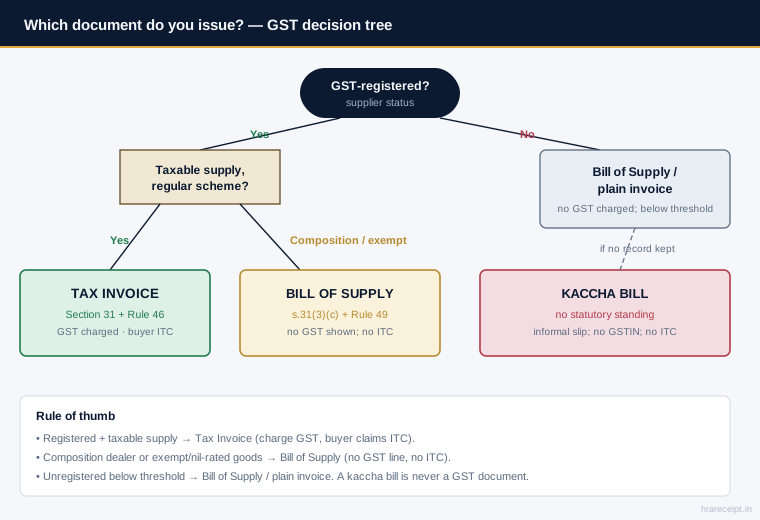
Three cases trigger it: below-threshold unregistered, exempt supplies, or a composition-scheme dealer.
The choice is set by your registration status, not by the look of the document. A registered regular supplier making a taxable supply issues a tax invoice; a composition or exempt-goods supplier, or an unregistered seller below the threshold, issues a bill of supply. A kaccha bill, the informal slip with no GSTIN and no tax split, is none of these and is not a GST document at all.
- You are below the GST threshold (Rs. 20 lakh aggregate annual turnover, or Rs. 10 lakh in special-category states) and have not voluntarily registered.
- You are registered but supplying exempt goods or services, such as educational services or healthcare.
- You are a composition-scheme dealer (turnover up to Rs. 1.5 crore, taxed at a fixed rate without ITC); composition dealers issue bills of supply, not tax invoices.
- A registered regular taxpayer making a taxable supply must issue a tax invoice, never a bill of supply; the two are not interchangeable.
What fields are mandatory on a bill of supply under Rule 49?
Short answer
Under Rule 49 of the CGST Rules[1] the document must be titled 'BILL OF SUPPLY' and carry these fields.
- Supplier name and address; GSTIN is omitted for unregistered suppliers, but composition or exempt suppliers include theirs.
- A unique serial number, in one or multiple series, not exceeding 16 characters of alphabets, numbers, and special characters.
- Date of issue, plus recipient name, address, and (if available) GSTIN.
- HSN/SAC code and description of the goods or services.
- Value of supply with no tax breakdown; bills of supply do not show CGST/SGST/IGST.
- Signature or digital signature of the supplier or authorised representative.
How does a bill of supply differ from a tax invoice?
Short answer
Both share most fields, but only a tax invoice shows GST line items and generates ITC.
A B2B buyer asking specifically for ITC must source from a registered supplier; a bill of supply will not satisfy that need.
| Element | Tax invoice | Bill of supply |
|---|---|---|
| Title | TAX INVOICE | BILL OF SUPPLY |
| Supplier GSTIN | Shown | Omitted (or composition GSTIN) |
| CGST/SGST/IGST lines | Shown | None |
| Tax-rate column | Per item | None |
| Total value | With tax | Excludes GST |
| Buyer ITC | Available | Not available |
Bill of supply vs tax invoice. Source: Rule 46 and Rule 49, CGST Rules 2017, CBIC.
Should you voluntarily register for GST below the threshold?
Short answer
Register if B2B clients need ITC or your input GST is large enough to recover; otherwise the compliance cost usually loses.
For a freelancer billing Rs. 5-8 lakh annually with mostly individual clients, staying unregistered and issuing bills of supply usually wins on net.
- Register if B2B clients require ITC, since corporate buyers often will not engage suppliers who cannot issue tax invoices.
- Register if input costs carry significant GST: Rs. 5 lakh of inputs at 18% is Rs. 75,000 of input tax to offset against output tax.
- Register if you are approaching the Rs. 20 lakh threshold organically and want to avoid a mid-year transition.
- Against it: registration adds monthly GSTR-1, GSTR-3B and annual GSTR-9 filings, accountant fees, and late fees if missed.
How do you explain a bill of supply to a client who demands a tax invoice?
Short answer
State that you are below the Rs. 20 lakh registration threshold[3], so Section 31(3)(c) requires a bill of supply, not a tax invoice.
- You have no GSTIN, so no GST is charged and no GST line items appear.
- The bill of supply is still valid proof of expense for their income tax and accounting records.
- They cannot claim ITC on this transaction because no GST is collected.
- If a corporate AP process accepts only tax invoices, voluntary registration or a higher rate to offset their lost ITC may be the only path.
How do you generate a compliant bill of supply quickly?
Short answer
Use the pakka bill generator; leave the GSTIN field blank and the title renders as 'BILL OF SUPPLY'. Proofread free, Rs. 5 for the final PDF.
Save your business profile so each repeat document takes about 30 seconds. Pair it with a payment receipt once funds clear, carrying the UTR number for digital transfers and a revenue stamp placeholder for cash above Rs. 5,000. This two-document workflow is the cleanest paper trail for unregistered service providers handling B2B clients.
References
- 1.Rule 49, Central Goods and Services Tax Rules 2017 — CBIC — Bill of supply mandatory fields
- 2.Section 31(3)(c), CGST Act 2017 — CBIC — Statutory basis for bill of supply
- 3.GST registration threshold notification — CBIC — Rs. 20 lakh / Rs. 10 lakh special-category-state threshold