GST · 17 June 2026
GST Reverse Charge: When Does a Small Business Pay for Its Supplier?
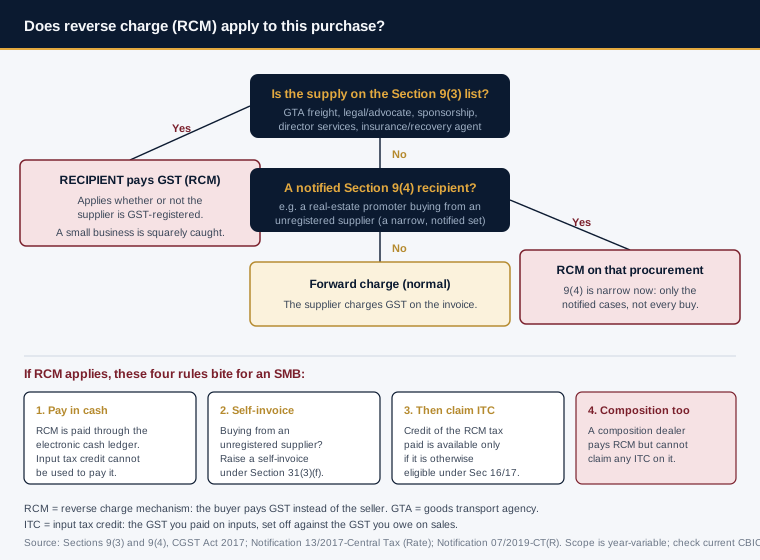
Reverse charge (RCM) means the buyer pays GST to the government instead of the supplier collecting it. It applies in two cases: Section 9(3) of the CGST Act, a notified list of supplies such as a goods transport agency, advocate or legal services, sponsorship, and a director's services to the company; and Section 9(4), a now-narrow set of cases where a notified recipient buys from an unregistered supplier. A small GST-registered business is squarely caught by the Section 9(3) list, must pay the tax in cash and not from input tax credit, must raise a self-invoice under Section 31(3)(f) when the supplier is unregistered, and stays liable even under the composition scheme, where no credit can be claimed on the RCM paid.
By Mrs. Swapna Patel
Published on 17 June 2026
Last modified on 23 August 2026
By Mrs. Swapna Patel
Published 17 June 2026
Updated 23 August 2026
In this section
Answers
- GST Reverse Charge: When Does a Small Business Pay for Its Supplier?
- What does a ₹1 revenue stamp on a rent receipt actually prove?
- What turnover thresholds make GST registration mandatory in 2026?
- GSTR-1, GSTR-2B and GSTR-3B: Which GST Return Is Which, and How?
- What Must You Verify Before Submitting Your ITR for AY 2026-27?
- What Is the Time of Supply Under GST, and When Does Tax Become Due?
- What Is the Value of Supply Under Section 15 of the CGST Act?
- What Are the GST Rate Slabs in India After the GST 2.0 Reform?
- Exempt vs Nil-Rated vs Zero-Rated Supply: What Is the Difference?
- Composite vs Mixed Supply Under Section 8: Which GST Rate Applies?
Reverse charge is a big-company problem; if my supplier is not GST-registered, I owe nothing.
Under Section 9(3) of the CGST Act[1], a registered small business pays GST itself on notified supplies like a goods transport agency or an advocate, whether the supplier is registered or not.
What is GST reverse charge, in one line?
Short answer
Reverse charge (RCM) flips the normal rule: under Section 9(3) and 9(4) of the CGST Act[1], the buyer pays GST straight to the government instead of the supplier charging it on the bill.
Normally the supplier adds GST to the invoice, collects it from you, and pays it to the government. That is called forward charge. Reverse charge moves that duty to you, the recipient. You compute the GST, pay it, and report it in your own returns.
- Forward charge: supplier charges GST on the invoice, you pay the supplier, the supplier pays the government.
- Reverse charge (RCM): the supplier does not charge GST; you pay it to the government yourself and report it in GSTR-3B.
- Why it matters: missing an RCM liability is your default, not the supplier's. The tax, interest, and penalty land on you, the buyer.
Does reverse charge apply to my small business?
Short answer
Yes, if you buy any supply on the Section 9(3) notified list[2]. A small GST-registered business that hires a goods transport agency or an advocate is caught, whatever the supplier's size or registration status.
There are two legs to RCM. Section 9(3) is a fixed list of notified goods and services where the buyer always pays. Section 9(4) is a narrow set of cases where a notified buyer purchases from an unregistered supplier. Most small businesses meet RCM through the Section 9(3) list.
- Section 9(3): a notified list under Notification 13/2017-Central Tax (Rate)[2]. If your purchase is on it, you pay RCM regardless of the supplier being registered or not.
- Section 9(4): once an omnibus rule, now suspended for general purchases and notified only for specific recipients, mainly a real-estate promoter buying from an unregistered supplier under Notification 07/2019-CT(R)[3]. Do not assume every purchase from an unregistered seller triggers RCM; for most buyers it does not.
- A composition dealer is not exempt. Composition covers your outward sales; it does not switch off your inward RCM liability.
- Why it matters: you can be fully compliant on your sales and still owe RCM on a freight bill or a lawyer's fee you never thought of as a GST event.
Which supplies fall under the Section 9(3) RCM list?
Short answer
The common ones for a small business are goods transport agency freight, advocate or legal services, sponsorship, a director's services to the company, an insurance agent, and a recovery agent, all notified under Notification 13/2017-CT(R)[2].
| Notified supply | Who pays GST (recipient) | Note for a small business |
|---|---|---|
| Goods transport agency (GTA) freight | The business paying the freight | A GTA is a road transporter that issues a consignment note. RCM is the default at 5% unless the GTA opts for forward charge. |
| Legal services by an advocate or law firm | The business engaging the advocate | Covers an individual advocate, a senior advocate, and a firm of advocates supplying to a business entity. |
| Sponsorship of an event | The body corporate or firm sponsoring | If you sponsor an event, you pay GST on the sponsorship under RCM. |
| Director's services to the company | The company | Sitting fees and similar payments to a director who is not an employee fall under RCM at the company's end. |
| Services of an insurance agent | The insurance company | The insurer, not the agent, pays the GST. |
| Services of a recovery agent | The bank or NBFC | The financial institution engaging the agent pays under RCM. |
A working subset of Notification 13/2017-Central Tax (Rate)[2]; the full notification carries more entries. GTA = goods transport agency; NBFC = non-banking financial company. The list is amended from time to time, so check the current CBIC notification before relying on any single row.
How do I pay RCM, and can I claim it back?
Short answer
You pay RCM in cash through the electronic cash ledger, because Rule 85(4)[6] requires it and RCM tax is not "output tax" under Section 2(82)[4], so input tax credit cannot discharge it. You can then claim credit of that tax only if it is otherwise eligible.
- How it differs from a normal invoice: under forward charge the supplier issues a Rule 46 tax invoice charging GST and you claim credit against it; under RCM the supplier charges nothing, so the document trail starts with you and the tax goes straight to the government, not through the supplier.
- Pay in cash: RCM tax is not "output tax" under Section 2(82)[4], so it cannot be set off with existing input tax credit. Rule 85(4)[6] requires it to be paid from the electronic cash ledger, so it is a real cash outflow in the month of liability.
- Then claim it back: once paid, the RCM amount becomes input tax credit you can claim under Section 16[5], but only if the supply is otherwise eligible for credit and not blocked under Section 17.
- Self-invoice the unregistered supplier: Section 31(3)(f)[4] requires you to raise your own invoice for an RCM purchase from an unregistered person, because the supplier issues none. That self-invoice is the document supporting your credit.
- The composition trap: a composition dealer still pays RCM, but cannot take any input tax credit on it. For them RCM is a pure cost, never recoverable.
What happens if I miss an RCM liability?
Short answer
The liability is yours, not the supplier's. An unpaid RCM amount attracts the tax, plus interest under Section 50 and a penalty, and a missing self-invoice is itself a compliance gap.
- The default sits with you: because the law puts the duty on the recipient, a GST officer raises the demand on the buyer, not on the supplier who never charged the tax.
- Interest and penalty: unpaid RCM carries interest under Section 50 from the due date, and a separate penalty for the short payment, even if you later pay the tax.
- Lost or delayed credit: if you never self-invoiced and never paid the RCM, you also never earned the input tax credit, so the cost compounds, the cash you should have recovered stays unrecovered.
- A clean trail helps: a pakka bill or self-invoice carrying every required field, plus a record of the RCM paid, is what an officer expects to see at audit. For the field anatomy, see what fields a GST tax invoice must carry, and for the document type, pakka bill vs kaccha bill.
References
- 1.Section 9, Central Goods and Services Tax Act 2017 — CBIC — Section 9(3) notified reverse-charge supplies; Section 9(4) registered recipient from unregistered supplier.
- 2.Notification 13/2017-Central Tax (Rate) — CBIC — The notified list of services taxed under reverse charge: GTA, legal services, sponsorship, director services, insurance agent, recovery agent, and more.
- 3.Notification 07/2019-Central Tax (Rate) — CBIC — Section 9(4) reverse charge for real-estate promoters on the shortfall below 80% registered procurement.
- 4.Section 31(3)(f) and Section 2(82), CGST Act 2017 — CBIC — Self-invoice on inward RCM supply from an unregistered person; RCM liability is not "output tax" under Section 2(82), so it cannot be set off from the input tax credit ledger.
- 5.Section 16, Central Goods and Services Tax Act 2017 — CBIC — Input tax credit conditions; RCM tax paid in cash becomes creditable if the supply is otherwise eligible and not blocked under Section 17.
- 6.Rule 85(4), Central Goods and Services Tax Rules 2017 — CBIC — The amount payable under reverse charge is to be discharged from the electronic cash ledger.
References & related
Primary sources
- Section 9, Central Goods and Services Tax Act 2017 — CBICSection 9(3) notified reverse-charge supplies; Section 9(4) registered recipient from unregistered supplier.
- Notification 13/2017-Central Tax (Rate) — CBICThe notified list of services taxed under reverse charge: GTA, legal services, sponsorship, director services, insurance agent, recovery agent, and more.
- Notification 07/2019-Central Tax (Rate) — CBICSection 9(4) reverse charge for real-estate promoters on the shortfall below 80% registered procurement.
- Section 31(3)(f) and Section 2(82), CGST Act 2017 — CBICSelf-invoice on inward RCM supply from an unregistered person; RCM liability is not "output tax" under Section 2(82), so it cannot be set off from the input tax credit ledger.
- Section 16, Central Goods and Services Tax Act 2017 — CBICInput tax credit conditions; RCM tax paid in cash becomes creditable if the supply is otherwise eligible and not blocked under Section 17.
- Rule 85(4), Central Goods and Services Tax Rules 2017 — CBICThe amount payable under reverse charge is to be discharged from the electronic cash ledger.