Tax Guide · 2 September 2026
What does a ₹1 revenue stamp on a rent receipt actually prove?
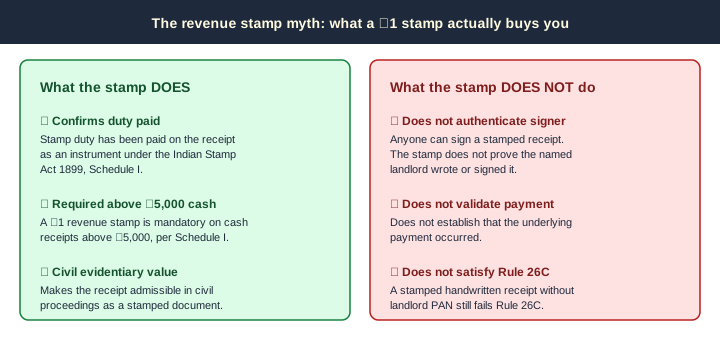
A ₹1 revenue stamp is a stamp-duty instrument under Schedule I, Article 53 of the Indian Stamp Act 1899, required on a receipt for money above ₹5,000 when the payment is made in cash. The stamp confirms one thing only: that the prescribed duty has been paid on the receipt as a document, which gives it civil evidentiary value as a stamped instrument. It does not authenticate whoever signed it, prove that the rent was actually paid, or satisfy Rule 26C of the Income Tax Rules 1962, the employer-side verification that activates when annual rent crosses ₹1,00,000. Those live in the Income Tax Act and Rules, not the Stamp Act. A Rule 26C-ready receipt is typed, carries the landlord PAN (or a CBDT Circular 8/2013 declaration where there is genuinely no PAN), references a bank UTR, and matches a bank-trail entry. The stamp can sit on that receipt or not; its presence does not strengthen those checks and its absence does not weaken them.
By Mrs. Kritika Joshi
Published on 2 September 2026
Last modified on 2 September 2026
By Mrs. Kritika Joshi
Published 2 September 2026
Updated 2 September 2026
In this section
Answers
- What does a ₹1 revenue stamp on a rent receipt actually prove?
- What turnover thresholds make GST registration mandatory in 2026?
- GSTR-1, GSTR-2B and GSTR-3B: Which GST Return Is Which, and How?
- What Is the Time of Supply Under GST, and When Does Tax Become Due?
- What Is the Value of Supply Under Section 15 of the CGST Act?
- What Are the GST Rate Slabs in India After the GST 2.0 Reform?
- Exempt vs Nil-Rated vs Zero-Rated Supply: What Is the Difference?
- Composite vs Mixed Supply Under Section 8: Which GST Rate Applies?
- What Is TCS Under GST? The Tax E-Commerce Platforms Collect
- Electronic Credit Ledger vs Cash Ledger: What Is the Difference?
A revenue stamp makes a rent receipt valid proof for an HRA claim.
The ₹1 stamp confirms only that stamp duty was paid on the receipt as a document under the Indian Stamp Act 1899, Schedule I[1]; it does not authenticate the signer, prove the payment, or satisfy the Rule 26C[2] landlord-PAN verification an employer runs above ₹1 lakh annual rent.
What does a ₹1 revenue stamp on a rent receipt prove?
Short answer
It proves one thing: that stamp duty has been paid on the receipt as a document. Under Schedule I, Article 53 of the Indian Stamp Act 1899[1], a receipt for money above ₹5,000 paid in cash carries a ₹1 revenue stamp, and that stamp gives the receipt civil evidentiary value as a stamped instrument.
The stamp is a Stamp Act instrument, not an Income Tax one. It says the duty due on the paper has been paid; it says nothing about who signed it, whether the rent was really paid, or whether the receipt satisfies HRA rules. An unstamped cash receipt above ₹5,000 is not admissible as a stamped instrument in a civil dispute; a stamped one is. That is the whole of what the stamp buys.
When is a revenue stamp actually required on a receipt?
Short answer
Only on a cash receipt for money above ₹5,000. Under Article 53 of the Indian Stamp Act 1899[1] the ₹1 stamp attaches to the receipt as an instrument; digital payments (UPI, NEFT, IMPS, card) leave their own bank trail and are treated as exempt in practice.
- The trigger is the ₹5,000 amount and the cash mode together; a receipt for ₹4,000 needs no stamp, and a ₹20,000 bank-transfer receipt needs no stamp in practice because the transfer itself is the evidence.
- The stamp is affixed on the receipt and signed across; the signature crossing the stamp is a cancellation formality, not an identity check.
- Why it matters: for most tenants in 2026 rent moves by bank transfer, so the revenue stamp is a cash-era formality that most compliant receipts no longer need at all.
Does a revenue stamp authenticate the landlord or prove the rent was paid?
Short answer
No on both counts. Anyone can sign across a stamp, so it authenticates no one; and a stamped receipt without a matching bank transfer, UTR, or AIS[4] entry is a stamped assertion of payment, not evidence one happened.
- The stamp is bought at a post office or stationery counter by anyone; the act of stamping carries no information about who executed the receipt or whether the named landlord agreed to it.
- A payment is proved by the bank trail, not the paper: a UTR on the receipt that maps to a statement entry is what a verifier reconciles against.
- Rent above ₹50,000 a month triggers tenant-side TDS under Section 194-IB[4] (2% since 1 October 2024), deposited by the tenant via Form 26QC, which then appears in the landlord's Form 26AS and AIS against the landlord PAN; a stamped receipt that diverges from that trail is flagged whether or not it carries a stamp.
- Why it matters: relying on a stamped cash receipt with no bank trail leaves the tenant unable to answer the one question scrutiny asks, was this rent actually paid, to whom.
Does a revenue stamp satisfy Rule 26C for an HRA claim?
Short answer
No. Rule 26C[2] activates when annual rent crosses ₹1,00,000 and asks the employer to collect the landlord's name, address, and PAN, or a CBDT Circular 8/2013[3] declaration where there is genuinely no PAN. The stamp touches none of those fields.
Rule 26C lives in the Income Tax Rules; the stamp lives in the Stamp Act. A stamped handwritten receipt with no landlord PAN still fails Rule 26C, and an unstamped typed receipt that carries the PAN and a UTR passes it. The stamp and the verification run on separate tracks.
- Above ₹1 lakh annual rent, the employer cannot grant HRA exemption in the TDS computation without the landlord PAN or the CBDT 8/2013 declaration on file.
- A landlord with genuinely no PAN gives a plain-paper declaration under CBDT Circular 8/2013[3]; the stamp is no substitute for it.
- Why it matters: a tenant leaning on a stamped receipt without the PAN is exposed to HRA disallowance at faceless scrutiny, and the employer to a Section 201 interest claim.
What makes a rent receipt actually stand up in 2026?
Short answer
Four fields, none of them the stamp: the landlord PAN (or a CBDT 8/2013 declaration), a bank UTR that reconciles against AIS[4], sequential monthly numbering, and a matching bank-trail entry. Faceless Assessment[5] reads those signals; it does not read stamps.
- Landlord PAN as a structured, format-valid field where annual rent crosses ₹1 lakh, with the CBDT 8/2013 declaration as the only substitute.
- A UTR or bank-transfer reference on each monthly receipt, so the amount matches the landlord Form 26AS/AIS line the Section 194-IB tenant-TDS trail creates on rent above ₹50,000 a month.
- Sequential numbering that increments one per month across twelve months; a bundle that clusters in one signing session is a manufactured-bundle signal.
- The working rule: treat the revenue stamp as legacy cash-receipt hygiene, not compliance armour. For the full audit view, see typed vs handwritten rent receipts under Rule 26C.
References
- 1.Indian Stamp Act 1899, Schedule I (Article 53 — receipt) — India Code — Stamp duty on a receipt for money; the ₹1 revenue stamp on cash receipts above ₹5,000, and its evidentiary effect as a stamped instrument.
- 2.Rule 26C, Income Tax Rules 1962 — Income Tax Department — Employer-side HRA verification: landlord name, address, and PAN once annual rent crosses ₹1,00,000.
- 3.CBDT Circular No. 8/2013 (landlord PAN declaration) — Income Tax Department — Plain-paper declaration a landlord without a PAN gives, filed by the tenant with the employer; the Rule 26C substitute for the landlord PAN.
- 4.Section 194-IB, Income Tax Act 1961 (tenant TDS on rent) — Income Tax Department — Rent above ₹50,000 a month triggers tenant-side TDS at 2% (since 1 October 2024), deposited via Form 26QC; it then appears in the landlord Form 26AS/AIS against the landlord PAN, the check a UTR-referenced receipt reconciles against.
- 5.Section 144B, Income Tax Act 1961 (Faceless Assessment) — Income Tax Department — End-to-end faceless HRA scrutiny; anomalous receipts route to algorithmic flagging where a stamp adds no signal.
References & related
Primary sources
- Indian Stamp Act 1899, Schedule I (Article 53 — receipt) — India CodeStamp duty on a receipt for money; the ₹1 revenue stamp on cash receipts above ₹5,000, and its evidentiary effect as a stamped instrument.
- Rule 26C, Income Tax Rules 1962 — Income Tax DepartmentEmployer-side HRA verification: landlord name, address, and PAN once annual rent crosses ₹1,00,000.
- CBDT Circular No. 8/2013 (landlord PAN declaration) — Income Tax DepartmentPlain-paper declaration a landlord without a PAN gives, filed by the tenant with the employer; the Rule 26C substitute for the landlord PAN.
- Section 194-IB, Income Tax Act 1961 (tenant TDS on rent) — Income Tax DepartmentRent above ₹50,000 a month triggers tenant-side TDS at 2% (since 1 October 2024), deposited via Form 26QC; it then appears in the landlord Form 26AS/AIS against the landlord PAN, the check a UTR-referenced receipt reconciles against.
- Section 144B, Income Tax Act 1961 (Faceless Assessment) — Income Tax DepartmentEnd-to-end faceless HRA scrutiny; anomalous receipts route to algorithmic flagging where a stamp adds no signal.