GST · 25 June 2026
What Is the GST Composition Scheme Under Section 10?
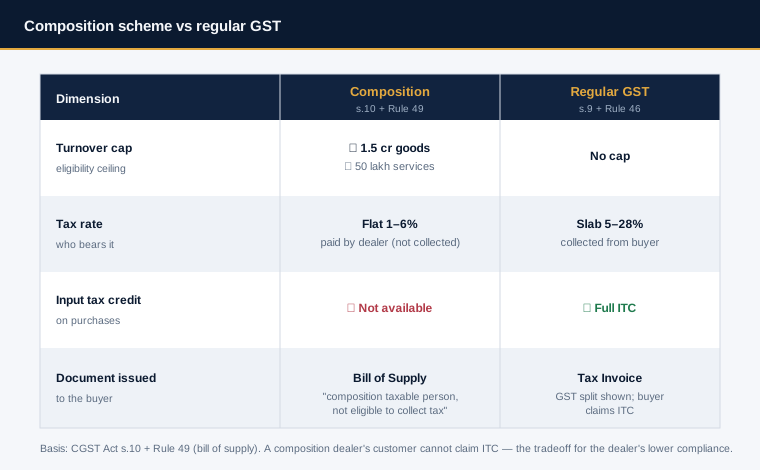
The composition scheme is GST's simplified track for small businesses under Section 10 of the CGST Act. A dealer with aggregate turnover up to ₹1.5 crore for goods (₹50 lakh for the separate service composition) pays a flat rate, 1% for traders and manufacturers, 5% for restaurants, 6% for the service composition, out of their own pocket. In exchange they give up two things: they cannot collect GST from customers, and they cannot claim input tax credit. Because no tax is collected, a composition dealer issues a bill of supply under Rule 49, not a tax invoice, and it must carry the declaration "composition taxable person, not eligible to collect tax on supplies". The scheme suits businesses selling to end-consumers, but makes a supplier more expensive to a B2B buyer who loses the credit.
By Mrs. Swapna Patel
Published on 25 June 2026
Last modified on 26 June 2026
By Mrs. Swapna Patel
Published 25 June 2026
Updated 26 June 2026
In this section
Answers
- What Is the GST Composition Scheme Under Section 10?
- What does a ₹1 revenue stamp on a rent receipt actually prove?
- What turnover thresholds make GST registration mandatory in 2026?
- GSTR-1, GSTR-2B and GSTR-3B: Which GST Return Is Which, and How?
- What Is the Time of Supply Under GST, and When Does Tax Become Due?
- What Is the Value of Supply Under Section 15 of the CGST Act?
- What Are the GST Rate Slabs in India After the GST 2.0 Reform?
- Exempt vs Nil-Rated vs Zero-Rated Supply: What Is the Difference?
- Composite vs Mixed Supply Under Section 8: Which GST Rate Applies?
- What Is TCS Under GST? The Tax E-Commerce Platforms Collect
The composition scheme just means a lower GST rate that you still charge your customers.
Under Section 10 of the CGST Act[1], a composition dealer pays a flat 1–6% out of their own pocket, cannot collect GST from buyers, and issues a bill of supply, not a tax invoice.
What is the GST composition scheme?
Short answer
A simplified GST track under Section 10 of the CGST Act[1]: a small dealer pays a flat rate on turnover instead of the normal slab, but cannot collect GST from customers or claim input tax credit.
- It is opt-in, for a registered person whose aggregate turnover is within the cap.
- The dealer pays the flat tax themselves; it never appears as a separate line the customer pays.
- No input tax credit: the low flat rate is the trade-off for losing the credit chain on purchases.
- Why it matters: the scheme cuts compliance to a quarterly payment and a simpler return, but is a poor fit for a supplier whose customers are registered businesses needing credit.
Who is eligible, and what is the turnover cap?
Short answer
A supplier of goods with aggregate turnover up to ₹1.5 crore, or a service provider up to ₹50 lakh under the separate service composition. Cross either ceiling and the dealer must move to the regular scheme.
- Goods and restaurants: aggregate turnover up to ₹1.5 crore (₹75 lakh in some special-category states).
- Services: a separate composition route under Section 10(2A), up to ₹50 lakh turnover.
- Excluded: inter-state outward suppliers, e-commerce sellers liable to TCS, and suppliers of goods outside the GST net cannot opt in.
- Why it matters: eligibility is tested on aggregate, PAN-level turnover, so all your GST registrations count toward the cap, not one branch.
What flat rate does a composition dealer pay?
Short answer
A flat rate on turnover under Section 10[1]: 1% for traders and manufacturers, 5% for restaurants (without alcohol), and 6% for the service composition, paid by the dealer, not collected from the buyer.
| Business type | Composition rate | Versus regular GST |
|---|---|---|
| Traders and manufacturers | 1% of turnover | Standard 5%–18% slab (40% sin/luxury), collected from buyer |
| Restaurants (not serving alcohol) | 5% of turnover | Standard slab, full ITC available |
| Service composition (Section 10(2A)) | 6% of turnover | Standard slab on each service |
Source: Section 10, CGST Act 2017[1]. The dealer pays this out of pocket because the scheme bars collecting GST from customers. See the composition vs regular GST exhibit.
What document does a composition dealer issue?
Short answer
A bill of supply under Rule 49[3], not a tax invoice, marked with the declaration "composition taxable person, not eligible to collect tax on supplies".
- No GST is collected, so there is no tax line to put on a tax invoice; the bill of supply replaces it.
- The Rule 5(1)(f) declaration is mandatory and verbatim, so the buyer knows there is no GST to claim.
- For how the composition bill of supply differs from the unregistered-seller bill of supply, see composition or unregistered: which bill of supply, when.
- A bill of supply generator carries the Rule 49 fields and the composition declaration, so the document is compliant from the first download.
References
- 1.Section 10, Central Goods and Services Tax Act 2017 (composition levy) — India Code — The composition scheme: turnover eligibility, the flat rate, and the bar on collecting tax or claiming credit.
- 2.Rule 5, Central Goods and Services Tax Rules 2017 (composition conditions) — CBIC — Conditions and restrictions for a composition taxable person.
- 3.Rule 49, Central Goods and Services Tax Rules 2017 (bill of supply) — CBIC — The document a composition dealer issues in place of a tax invoice.
- 4.GST portal — CBIC — Official composition-scheme rates and eligibility reference.
References & related
Primary sources
- Section 10, Central Goods and Services Tax Act 2017 (composition levy) — India CodeThe composition scheme: turnover eligibility, the flat rate, and the bar on collecting tax or claiming credit.
- Rule 5, Central Goods and Services Tax Rules 2017 (composition conditions) — CBICConditions and restrictions for a composition taxable person.
- Rule 49, Central Goods and Services Tax Rules 2017 (bill of supply) — CBICThe document a composition dealer issues in place of a tax invoice.
- GST portal — CBICOfficial composition-scheme rates and eligibility reference.