Anti-Fraud · 31 May 2026
Spotting AI-Generated Rent Receipts: 7 Tells
AI-generated rent receipts fail seven repeatable tests under Rule 26C scrutiny. Combined with a single Annual Information Statement reconciliation, an HR team rejects an AI bundle in under two minutes.
By Mr. Vihaan Jain
Published on 31 May 2026
Last modified on 31 May 2026
By Mr. Vihaan Jain
Published 31 May 2026
Updated 31 May 2026
In this section
Answers
- Spotting AI-Generated Rent Receipts: 7 Tells
- What does a ₹1 revenue stamp on a rent receipt actually prove?
- What turnover thresholds make GST registration mandatory in 2026?
- GSTR-1, GSTR-2B and GSTR-3B: Which GST Return Is Which, and How?
- What Must You Verify Before Submitting Your ITR for AY 2026-27?
- What Is the Time of Supply Under GST, and When Does Tax Become Due?
- What Is the Value of Supply Under Section 15 of the CGST Act?
- What Are the GST Rate Slabs in India After the GST 2.0 Reform?
- Exempt vs Nil-Rated vs Zero-Rated Supply: What Is the Difference?
- Composite vs Mixed Supply Under Section 8: Which GST Rate Applies?
What are the seven tells of an AI-generated rent receipt?
Short answer
AI-generated rent receipts fail seven repeatable tests under Rule 26C[1] verification: identical landlord signatures, calendar-impossible dates, PAN-stamp ink mismatch, copy-paste address blocks, round rent amounts, malformed PINs, and ITR boilerplate phrasing. A single Annual Information Statement[8] reconciliation closes the rest.
Through 2026, AI image generation has caught up to template fidelity on any single-receipt scan. What it has not caught up to is the cross-receipt and cross-system footprint a real twelve-month tenancy leaves on the AIS under Section 285BA[3]. Tells 1-7 are the fast filter; AIS is the conclusive filter; the verification QR short-circuits both.
- Identical landlord signature across twelve months. Real landlords sign with natural variance: slope, pressure, spacing. AI bundles match pixel-for-pixel across every receipt. Two side-by-side resolves it.
- Calendar-impossible or single-day-cluster dates. Receipt dated 31-Apr, 29-Feb in a non-leap year, or all twelve receipts on the same day-of-month. Real landlords issue when they collect; 2-4 days drift month-on-month is normal.
- PAN stamp in different ink from the body. Real PANs are stamped or hand-written in the same ink as the signature line. AI bundles render the PAN in a different font weight or colour the model invents as a stamp aesthetic.
- Copy-paste address blocks across allegedly different landlords. Multi-year submissions naming three landlords show identical PIN-format, identical commas, identical floor-prefix conventions. Real landlords format addresses idiosyncratically.
- Rent amounts ending in identical round thousands across all twelve months. Real rent carries deposit-adjustment paise or rent-revision arithmetic. AI bundles produce twelve receipts at exactly Rs 25,000.00 each. Cross-check against the rent agreement and the bank UTR trail.
- Missing or malformed PINs. Indian PINs are exactly six digits. AI bundles drop them, produce five-digit codes, or generate PINs that do not resolve on India Post pincode search[7].
- ITR boilerplate inside the receipt body. Real receipts say *received from*. AI receipts inject *for HRA exemption under Section 10(13A)* or *for Form 12BB submission*. Landlords do not think in tax-code vocabulary; only the tax filer does.
How does AI output differ from an HRAReceipt-generated receipt?
Short answer
Across all seven tells, an AI bundle and an HRAReceipt-generated receipt produce structurally different artefacts. The table maps each tell against AI behaviour, HRAReceipt generator behaviour, and the verifier cross-check that resolves it.
| Tell | AI bundle | HRAReceipt generator | Verifier cross-check |
|---|---|---|---|
| Landlord signature | Pixel-identical across 12 receipts | Single landlord-name field; signature line stays for pen-and-paper anchor | Two receipts side-by-side |
| Date stamps | Calendar-impossible or single-day cluster | Date picker rejects 31-Apr, 29-Feb non-leap, future dates | Form 12BB month declaration |
| PAN block | Different font or ink from receipt body | PAN-format validator (AAAAA9999A) on submit; structured field | IT Dept PAN Verification API + AIS reconciliation |
| Address blocks | Copy-paste style across allegedly different landlords | Typed once per landlord; PIN validated separately | India Post pincode + cross-receipt comparison |
| Rent amount | Identical round thousands across all 12 months | Per-month amount field; honours paise; deposit-adjustment line supported | AIS bank-channel rent line + Section 269ST cash cap |
| PIN code | Missing, 5-digit, or non-resolving | 6-digit validator on submit; rejects malformed PINs | India Post pincode lookup[7] |
| Receipt body phrasing | Injects tax-code vocabulary (Section 10(13A), Form 12BB) | Static "received from {tenant}" pattern; tax-code phrasing absent | Read the body line aloud |
Each tell mapped against AI behaviour, HRAReceipt-generated behaviour, and the verifier cross-check that resolves it.
What single cross-check beats every visual scan?
Short answer
The Annual Information Statement under Section 285BA[3]. Bank-channel rent above Rs 50,000 per month appears against both tenant and landlord PAN. A bundle claiming Rs 60,000 per month while AIS shows nothing, or the reverse, is rejected without scanning a single signature.
From FY 2025-26 the AIS rent line ingests bank-channel rent above Rs 50,000 per month via NEFT, IMPS, UPI, and RTGS. The mismatch engine runs automatically inside the Faceless Assessment system under Section 144B[6]. AI fabrications cannot create AIS entries. Cash-rent bundles separately face the Section 269ST cash transaction limit: aggregate receipts above Rs 2 lakh trigger a 100 percent penalty on the recipient. AIS and 269ST together leave AI bundles nowhere to hide.
What short-circuits the entire scan?
Short answer
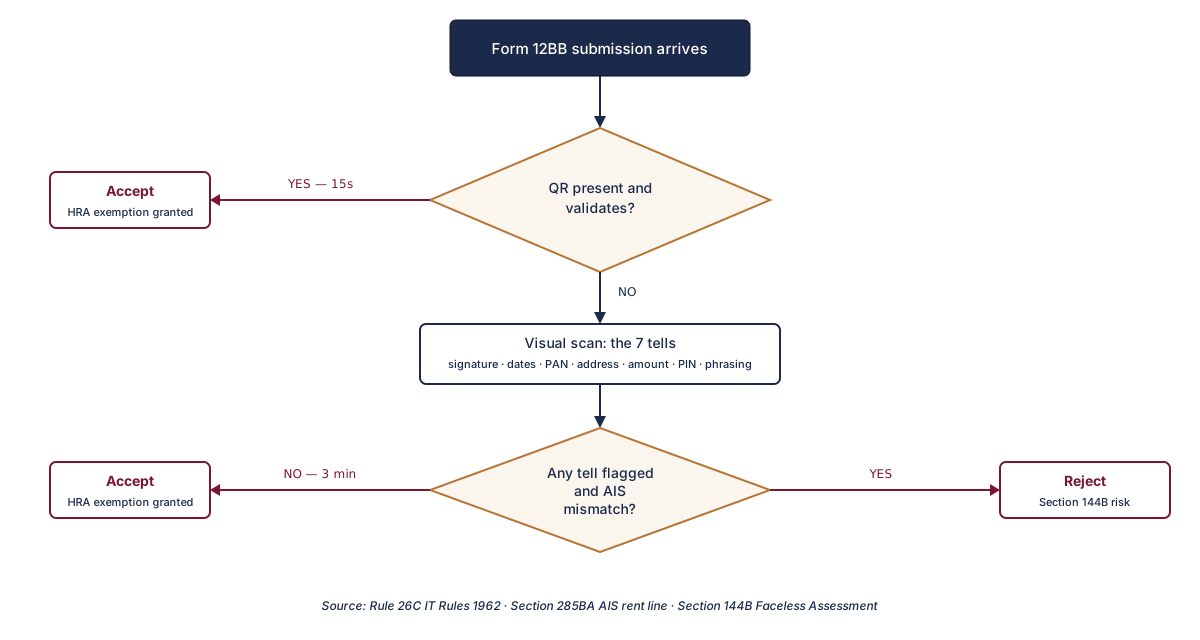
A receipt carrying a verification QR. The QR binds to document content at the moment of legitimate generation; any subsequent edit invalidates it. A two-second scan confirms authenticity and skips tells 1-7 for that document.
AI fabricates pixels. AI cannot fabricate a valid verification QR. For HR teams processing 200 Form 12BB[5] submissions per quarter, the QR path takes 10-20 percent of incoming receipts off the manual scan entirely. The seven signs of AI-generated salary slips covers the salary side; the typed-vs-handwritten audit under Rule 26C covers the broader receipt-validity question.
What is the 3-minute rent-receipt verification workflow?
Short answer
Six steps. QR scan first, fifteen seconds. If absent or invalid, run the visual scan against the seven tells, then pull the Annual Information Statement[8] for any flagged file. Total: under three minutes per receipt at sustained volume.
The workflow front-loads the cheapest checks. QR scan short-circuits 10-20 percent of bundles entirely. Visual scan catches another 60-70 percent at the surface. AIS reconciliation under Section 285BA[3] is the final filter for residual files. At 1,000-file daily HR volume, the cadence keeps throughput intact.
References
- 1.Rule 26C, Income Tax Rules 1962 — Employer evidence requirement when annual rent exceeds Rs 1 lakh.
- 2.Section 10(13A), Income Tax Act 1961 — House Rent Allowance exemption framework.
- 3.Section 285BA, Income Tax Act 1961 — AIS reporting basis. Rent line expansion from FY 2025-26.
- 4.Section 269ST, Income Tax Act 1961 — Cash receipt aggregate cap of Rs 2 lakh; 100 percent penalty.
- 5.Form 12BB (Rule 26C statement) PDF — Form fields include PAN or Aadhaar of landlord above Rs 1 lakh.
- 6.Section 144B, Income Tax Act 1961 — Faceless Assessment scheme; auto-routes low-structure inputs to manual review.
- 7.India Post Pincode Search — Official PIN code lookup; six-digit validation.
- 8.Annual Information Statement (AIS), Income Tax e-Filing portal — Taxpayer AIS access; bank-channel rent line reconciliation.
References & related
Primary sources
- Rule 26C, Income Tax Rules 1962Employer evidence requirement when annual rent exceeds Rs 1 lakh.
- Section 10(13A), Income Tax Act 1961House Rent Allowance exemption framework.
- Section 285BA, Income Tax Act 1961AIS reporting basis. Rent line expansion from FY 2025-26.
- Section 269ST, Income Tax Act 1961Cash receipt aggregate cap of Rs 2 lakh; 100 percent penalty.
- Form 12BB (Rule 26C statement) PDFForm fields include PAN or Aadhaar of landlord above Rs 1 lakh.
- Section 144B, Income Tax Act 1961Faceless Assessment scheme; auto-routes low-structure inputs to manual review.
- India Post Pincode SearchOfficial PIN code lookup; six-digit validation.
- Annual Information Statement (AIS), Income Tax e-Filing portalTaxpayer AIS access; bank-channel rent line reconciliation.