Tax Guide · 4 May 2026
Cash Receipt Limit Rs. 2 Lakh — What Is Section 269ST?
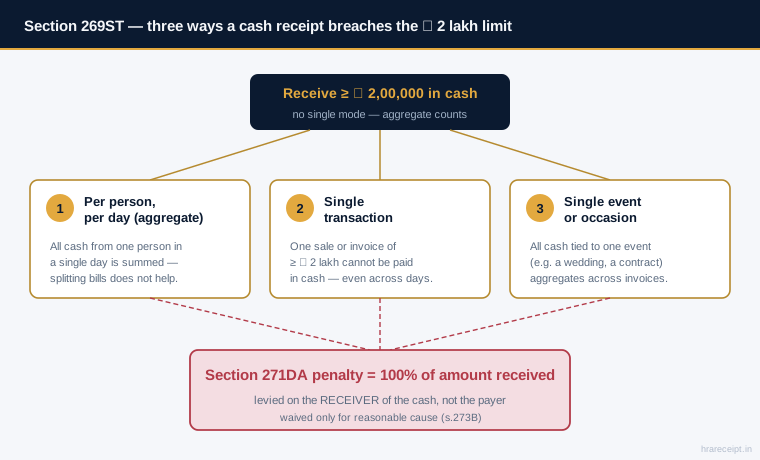
Section 269ST of the Income Tax Act, 1961 bars any person from receiving cash of ₹2,00,000 or more from a single person, whether in aggregate in a day, in a single transaction, or relating to one event or occasion. The penalty under Section 271DA equals 100% of the amount received, falling on the recipient regardless of intent.
By Mrs. Swapna Patel
Published on 4 May 2026
Last modified on 25 June 2026
By Mrs. Swapna Patel
Published 4 May 2026
Updated 25 June 2026
In this section
Answers
- Cash Receipt Limit Rs. 2 Lakh — What Is Section 269ST?
- What does a ₹1 revenue stamp on a rent receipt actually prove?
- What turnover thresholds make GST registration mandatory in 2026?
- GSTR-1, GSTR-2B and GSTR-3B: Which GST Return Is Which, and How?
- What Must You Verify Before Submitting Your ITR for AY 2026-27?
- What Is the Time of Supply Under GST, and When Does Tax Become Due?
- What Is the Value of Supply Under Section 15 of the CGST Act?
- What Are the GST Rate Slabs in India After the GST 2.0 Reform?
- Exempt vs Nil-Rated vs Zero-Rated Supply: What Is the Difference?
- Composite vs Mixed Supply Under Section 8: Which GST Rate Applies?
Section 269ST penalises the person who pays the cash, so as the receiver you are safe.
The opposite. Section 271DA[2] levies the 100% penalty on the person who *receives* Rs. 2 lakh or more in cash, regardless of who handed it over or why.
What is the Section 269ST cash receipt limit?
Short answer
Section 269ST[1] bars any person from receiving Rs. 2,00,000 or more in cash from a single person. It bites on the receiver, not the payer.
Introduced by the Finance Act 2017[4] in the demonetisation-era cashless push, the cap applies three ways, and breaching any one prong is enough.
- In aggregate from one person in a single day, even across several small cash handovers.
- In a single transaction, whatever the date split.
- Across transactions relating to one event or occasion, such as a wedding or property deal.
- The Rs. 2 lakh test is per receiver per source, so the same person can receive Rs. 1.99 lakh cash from two different people on the same day without breaching it.
What is the penalty for breaking Section 269ST?
Short answer
Under Section 271DA[2] the penalty equals 100% of the cash received, charged to the receiver, with no intent requirement.
- Accept Rs. 3,00,000 in cash from one person and the penalty is Rs. 3,00,000, separate from any tax on the income itself.
- The penalty falls on whoever receives the cash; there is no benefit-of-doubt or good-faith carve-out.
- The law does not require intent to evade tax. The act of receiving Rs. 2 lakh or more is the violation.
- The receiver carries the risk, so it is the receiver who should insist on a bank transfer above the limit.
Who is exempt from Section 269ST?
Short answer
Government bodies, banks, and post offices are exempt; cash loans and deposits sit under Section 269SS[3] with its own Rs. 20,000 limit instead.
- Government entities, banks, and post offices receiving cash are outside Section 269ST.
- Loans and deposits are governed by Section 269SS (Rs. 20,000 cash limit), not 269ST.
- Receipts by way of inheritance or will are exempt.
- No exemption covers rent collection, real estate payments, service fees, or ordinary business receipts. Those are squarely caught.
When does this catch landlords, sellers, and service providers?
Short answer
Any cash receipt of Rs. 2 lakh or more from one tenant, buyer, client, or family in a day or for one event breaches the cap.
Monthly rent paid in cash up to Rs. 1.99 lakh is technically within the wording, but the daily-aggregate prong means several cash payments from the same tenant on one day can still cross the line.
| Who receives | Caught when |
|---|---|
| Landlord | Cash rent or deposit of Rs. 2 lakh or more from one tenant in a day |
| Property seller | Cash earnest money, brokerage, or part payment above Rs. 2 lakh |
| Consultant / contractor / tutor | Cash above Rs. 2 lakh for a single contract or project |
| Caterer / decorator / tent house | Cash above Rs. 2 lakh for one event from a single family |
Common Rs. 2 lakh-plus cash receipts caught by Section 269ST. Source: Section 269ST, Income Tax Act 1961.
How do I stay compliant with Section 269ST?
Short answer
Take any payment of Rs. 2 lakh or more by UPI, NEFT, RTGS, account-payee cheque, or bank transfer, all of which fall outside Section 269ST.
- Banking-channel receipts create an audit trail and are exempt, so they remove the risk entirely.
- Watch the daily-aggregate prong: several sub-limit cash receipts from the same person in one day can still cross Rs. 2 lakh.
- Always issue a payment receipt recording the payment mode and the UTR or reference number, which protects both sides in any later inquiry.
- For the difference between an invoice, a receipt, and a quotation, see invoice vs receipt vs quotation.
References
- 1.Section 269ST, Income Tax Act 1961 — Income Tax Department — Rs. 2 lakh cash receipt prohibition
- 2.Section 271DA, Income Tax Act 1961 — Income Tax Department — 100% penalty on Section 269ST violations
- 3.Section 269SS, Income Tax Act 1961 — Income Tax Department — Separate Rs. 20,000 limit on cash loans and deposits
- 4.Finance Act 2017 — Ministry of Finance — Section 269ST introduction
References & related
Primary sources
- Section 269ST, Income Tax Act 1961 — Income Tax DepartmentRs. 2 lakh cash receipt prohibition
- Section 271DA, Income Tax Act 1961 — Income Tax Department100% penalty on Section 269ST violations
- Section 269SS, Income Tax Act 1961 — Income Tax DepartmentSeparate Rs. 20,000 limit on cash loans and deposits
- Finance Act 2017 — Ministry of FinanceSection 269ST introduction