Tax Guide · 4 May 2026
Rule 26C: What Must an Employer Verify Before Granting HRA Exemption?
Rule 26C of the Income Tax Rules, 1962 requires every employer to collect documentary proof via Form 12BB (Form 124 from 1 April 2026) for rent paid, landlord name, landlord address, and landlord PAN if annual rent exceeds Rs. 1,00,000 before granting HRA exemption under Section 10(13A) in the TDS computation under Section 192 (Section 392 under the Income-tax Act, 2025). Missing proof exposes the employer to disallowance during assessment.
By Mrs. Kritika Joshi
Published on 4 May 2026
Last modified on 19 June 2026
By Mrs. Kritika Joshi
Published 4 May 2026
Updated 19 June 2026
In this section
Answers
- Rule 26C: What Must an Employer Verify Before Granting HRA Exemption?
- What does a ₹1 revenue stamp on a rent receipt actually prove?
- What turnover thresholds make GST registration mandatory in 2026?
- GSTR-1, GSTR-2B and GSTR-3B: Which GST Return Is Which, and How?
- What Must You Verify Before Submitting Your ITR for AY 2026-27?
- What Is the Time of Supply Under GST, and When Does Tax Become Due?
- What Is the Value of Supply Under Section 15 of the CGST Act?
- What Are the GST Rate Slabs in India After the GST 2.0 Reform?
- Exempt vs Nil-Rated vs Zero-Rated Supply: What Is the Difference?
- Composite vs Mixed Supply Under Section 8: Which GST Rate Applies?
An employee self-declaration is enough for the employer to grant HRA exemption in salary TDS.
CBDT Circular No. 8/2013[4] instructs employers that HRA exemption cannot rest on a self-declaration alone; Rule 26C requires Form 12BB plus underlying rent receipts.
What does Rule 26C require an employer to do before granting HRA?
Short answer
Rule 26C of the Income Tax Rules, 1962[2], in force from 1 June 2016, makes the employer obtain a Form 12BB declaration plus rent receipts before applying HRA exemption under Section 10(13A) in any month's TDS computation.
- The Form 12BB declaration must capture rent paid, landlord name, landlord address, and the landlord's PAN if annual rent exceeds Rs. 1,00,000.
- The employer must retain the underlying rent receipts as evidence, not just the declaration.
- A self-declaration without supporting receipts is not Rule 26C compliance.
- This is what the assessing officer asks for if the deduction is later questioned.
How do Section 10(13A), Rule 26C, and Form 12BB connect?
Short answer
Section 10(13A) grants the exemption, Rule 26C puts the proof burden on the employer, and Form 12BB is the prescribed declaration tying them to Section 192 TDS[5].
See our Form 12BB submission guide for the employee-facing process.
- Section 10(13A) of the Income Tax Act, 1961 grants the employee HRA exemption against actual rent paid.
- Rule 26C, effective 1 June 2016 via the Finance Act 2015, places the proof-collection burden on the employer.
- Form 12BB, prescribed under Rule 26C, is the employee's declaration.
- Section 192 (now Section 392 under the Income-tax Act, 2025 for Tax Year 2026-27 onwards) covers TDS on salary.
- CBDT Circular No. 8/2013[4] bars granting HRA on a self-declaration alone.
What must the employee declare in Form 12BB for HRA?
Short answer
Form 12BB Part B (House Rent Allowance) requires four data points: rent paid, landlord name, landlord address with PIN, and the landlord PAN where annual rent exceeds Rs. 1,00,000[3].
Where the landlord genuinely has no PAN, the employee must furnish a written declaration from the landlord stating PAN is not held; it is not a substitute for PAN. Keep it on file with the receipts. See our Section 10(13A) rent-receipt checklist.
- Rent paid to the landlord during the financial year.
- Name of the landlord.
- Full address of the landlord, including PIN.
- PAN of the landlord, mandatory if total annual rent exceeds Rs. 1,00,000.
What is the verification checklist HR or payroll should run on each Form 12BB?
Short answer
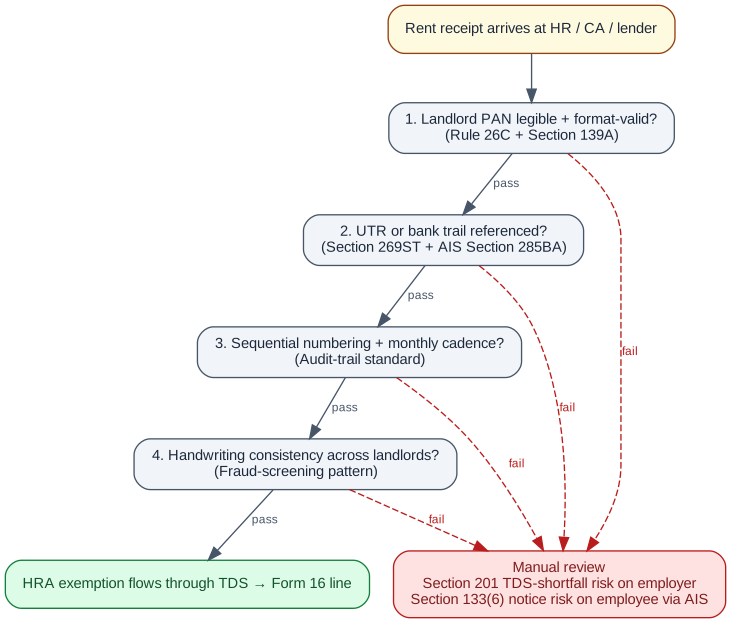
Run all eight checks before applying HRA in TDS, starting with the landlord PAN format AAAAA9999A[2] where rent crosses Rs. 1,00,000 per year.
- PAN format: the landlord PAN, where required, must be 10 characters in the pattern AAAAA9999A.
- Period coverage: monthly receipts must cover the period claimed; a single April-to-March bulk receipt is not Rule 26C compliance.
- Rent vs city plausibility: Rs. 75,000 per month against a Tier-3 town address is a flag.
- Mandatory fields: receipt number, date, tenant and landlord names, amount in figures and words, rental period, property address, payment mode, and landlord signature.
- Revenue stamp: cash receipts above Rs. 5,000 require a Re. 1 stamp under the Indian Stamp Act, 1899; digital payments (UPI, NEFT, IMPS, cards) are exempt.
- PAN-unavailable declaration on file where rent crosses Rs. 1,00,000, plus a tenant-name-to-PAN match and a check that salary HRA aligns with rent per the three-way minimum formula.
What does disallowance cost the employer and the employee?
Short answer
The employer faces interest under Section 201(1A) and penalty under Section 271C equal to the TDS not deducted; the employee loses the exemption with interest and penalty under Section 270A[7].
See Salary Slip and Form 16 Reconciliation for the line-by-line procedure.
- Under-deduction attracts interest under Section 201(1A) at 1% per month from when TDS was due, plus 1.5% per month from deduction to deposit.
- Penalty under Section 271C equals the TDS not deducted.
- The employer's salary expense may be disallowed under Section 40(a)(ia) if TDS compliance fails entirely.
- For the employee, the exemption is reversed during ITR scrutiny under Section 143(2), with tax demanded plus interest under Sections 234B and 234C.
- The employee may face penalty under Section 270A for under-reporting, typically 50% of the under-reported tax.
How does Rule 26C verification scale from 50 to 5,000 employees?
Short answer
Manual folders work up to 50 employees, a Form 12BB upload portal with 10-15% sample audits suits 50 to 500, and beyond 500 verification must be automated inside the payroll workflow.
| Headcount | Collection method | Verification approach |
|---|---|---|
| Up to 50 | Paper or PDF receipts collected once a year (typically January-February), folder per FY then per employee | One HR person runs the full eight-point checklist in a single sitting |
| 50 to 500 | Payroll software with a Form 12BB upload portal tracking completion | Run the eight-point checklist as a sample audit on 10-15% of submissions |
| 500-plus | Verification embedded in payroll: mandatory fields, format validation at upload, automated PAN-pattern matching | CBDT scrutiny focuses on the employer's process, not individual receipts |
Rule 26C verification by headcount. Source: Rule 26C, Income Tax Rules 1962.
What changed for Section 10(13A) HRA from 1 April 2026?
Short answer
Rule 26C and Form 12BB are unchanged, but HRA exemption under Section 10(13A) is now available only to employees who opt into the old tax regime via Form 10-IEA[8].
- The new regime, default since FY 2024-25, does not allow HRA exemption.
- Before applying HRA in TDS, the employer must obtain the employee's regime declaration.
- For old-regime continuers, Form 10-IEA must be filed before the ITR due date.
- The Rule 26C documentary proof remains required in addition to the regime declaration.
- The wider verification timeline sits alongside this regime change: PAN 2.0 instant e-PAN, the AIS rent-line expansion, the Form 12BB to Form 124 rename, and end-to-end Faceless Assessment under Section 144B all landed between July 2025 and FY 2026-27.

What common errors get caught in CBDT scrutiny?
Short answer
The most common technical default is a missing landlord PAN where rent crosses Rs. 1,00,000 per year[2]; without it Form 12BB cannot be processed for HRA.
See Rule 114B PAN collection thresholds for the parallel cash-deposit process.
- Identical handwriting across landlords, or twelve monthly receipts dated the same day in March, signals backdating. See the six attributes where handwritten receipts fail Rule 26C audit for the full breakdown.
- A landlord PAN not matching the e-Filing name database, or one PAN across unrelated employees, flags a fabricated or shared landlord.
- Missing revenue stamps on cash receipts above Rs. 5,000 stay acceptable under Section 10(13A) but mark casual preparation.
- Rent to a blood relative is permitted only if paid by bank transfer and declared in the relative's ITR; cash to a parent with no declared rental income is the classic disallowance.
- Over-stated rent fails: Rs. 25,000 monthly HRA cannot claim against Rs. 50,000 rent, since the three-way minimum formula caps the exemption at the salary HRA. The 24-city median rent analysis for 2026 shows exactly where rent plausibility thresholds sit.
References
- 1.Section 10(13A), Income Tax Act 1961 — Income Tax Department — Statutory grant of HRA exemption
- 2.Rule 26C, Income Tax Rules 1962 — Income Tax Department — Employer documentary proof requirement
- 3.Form 12BB — Income Tax Department — Employee declaration form
- 4.CBDT Circular No. 8/2013 — Income Tax Department — Employer responsibility for HRA verification
- 5.Section 192, Income Tax Act 1961 — Income Tax Department — TDS on salary
- 6.Section 271C, Income Tax Act 1961 — Income Tax Department — Penalty for failure to deduct TDS
- 7.Section 270A, Income Tax Act 1961 — Income Tax Department — Penalty for under-reporting of income
- 8.Form 10-IEA — Income Tax Department — Opt-in to the old tax regime to retain HRA exemption
References & related
Primary sources
- Section 10(13A), Income Tax Act 1961 — Income Tax DepartmentStatutory grant of HRA exemption
- Rule 26C, Income Tax Rules 1962 — Income Tax DepartmentEmployer documentary proof requirement
- Form 12BB — Income Tax DepartmentEmployee declaration form
- CBDT Circular No. 8/2013 — Income Tax DepartmentEmployer responsibility for HRA verification
- Section 192, Income Tax Act 1961 — Income Tax DepartmentTDS on salary
- Section 271C, Income Tax Act 1961 — Income Tax DepartmentPenalty for failure to deduct TDS
- Section 270A, Income Tax Act 1961 — Income Tax DepartmentPenalty for under-reporting of income
- Form 10-IEA — Income Tax DepartmentOpt-in to the old tax regime to retain HRA exemption