GST · 16 June 2026
GST Tax Invoice (Pakka Bill): Rule 46 Fields and When It Is Valid
A GST tax invoice, the "pakka bill", is the only document that lets a buyer claim input tax credit and holds up in a GST audit. This guide covers the whole invoice: how a pakka bill differs from a kaccha slip, every field Rule 46 demands, the CGST/SGST/IGST split, HSN/SAC codes, B2B versus B2C rules, what is not a tax invoice (proforma, quotation, advance receipt), the mistakes that trigger a Section 122 notice, whether ₹5 crore e-invoicing reaches you, and how to switch from a kaccha bill to a compliant one.
By Mrs. Swapna Patel
Published on 16 June 2026
Last modified on 17 August 2026
By Mrs. Swapna Patel
Published 16 June 2026
Updated 17 August 2026
In this section
Answers
- GST Tax Invoice (Pakka Bill): Rule 46 Fields and When It Is Valid
- What does a ₹1 revenue stamp on a rent receipt actually prove?
- What turnover thresholds make GST registration mandatory in 2026?
- GSTR-1, GSTR-2B and GSTR-3B: Which GST Return Is Which, and How?
- What Must You Verify Before Submitting Your ITR for AY 2026-27?
- What Is the Time of Supply Under GST, and When Does Tax Become Due?
- What Is the Value of Supply Under Section 15 of the CGST Act?
- What Are the GST Rate Slabs in India After the GST 2.0 Reform?
- Exempt vs Nil-Rated vs Zero-Rated Supply: What Is the Difference?
- Composite vs Mixed Supply Under Section 8: Which GST Rate Applies?
A kaccha bill, the rough slip a shop hands you, is still a valid bill for tax and accounts.
Only a pakka bill, a GST tax invoice carrying the Rule 46[2] fields, lets the buyer claim input tax credit; a kaccha bill on a taxable sale costs the buyer that credit and exposes the seller to a Section 122[5] penalty at audit.
Full guide below — click any section to collapse.
Pakka bill vs kaccha bill: which is a valid GST invoice?
Short answer
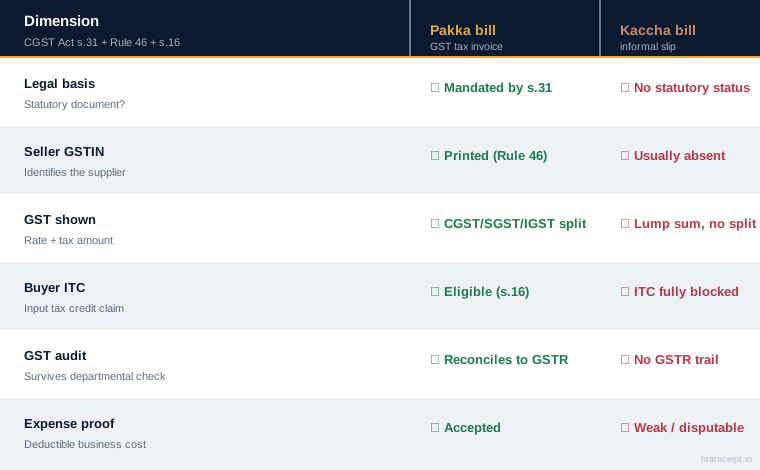
A pakka bill is a GST tax invoice raised under Section 31 of the CGST Act[1] with the mandatory fields in Rule 46[2]. A kaccha bill is an informal slip, often handwritten, with no GSTIN and no tax breakup, so only the pakka bill carries input tax credit and audit standing.
- Pakka bill: a tax invoice carrying the seller's GSTIN, a consecutive invoice number, the GST rate and amount, and the buyer's details. It is the only sale document the law recognises for input tax credit.
- Kaccha bill: a rough estimate, cash memo, or handwritten note that records an amount without the GST detail the law requires. Fine as a personal note, never as a tax document on a taxable sale.
- When is an informal slip actually fine? Only when you are below the GST registration threshold and unregistered. You then issue no tax invoices at all, so a plain receipt or cash memo is enough to record the sale; there is no GST to break up and no input tax credit to pass on.
- Even then, a bill of supply under Rule 49 beats a bare slip: it is a real GST document that simply carries no tax, so it is cleaner expense proof than a rough note. A kaccha bill stops being fine the moment you are registered, because Section 31[1] then makes a tax invoice mandatory on every taxable sale.
| Pakka bill (tax invoice) | Kaccha bill (informal slip) | |
|---|---|---|
| Legal basis | Section 31 + Rule 46, CGST | None |
| Seller GSTIN | Printed on the bill | Absent |
| GST shown | CGST + SGST, or IGST | Not shown |
| Buyer claims input tax credit | Yes | No |
| Holds up in a GST audit | Yes | No |
| Expense proof for the buyer | Full | Weak, often rejected |
A kaccha bill may record the sale, but only a pakka bill carries the input tax credit and the audit trail.
What fields must a GST tax invoice carry under Rule 46?
Short answer
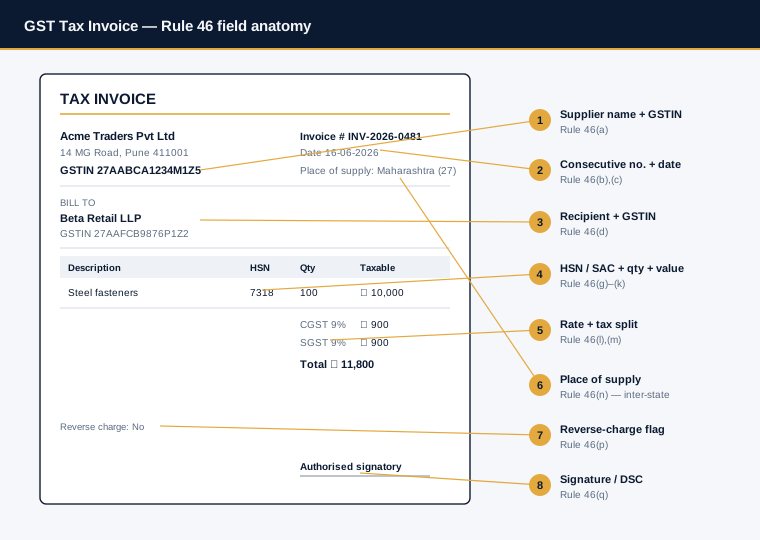
Section 31 of the CGST Act[1] requires a registered supplier to issue a tax invoice, and Rule 46[2] fixes the particulars, clauses (a) to (s). A document missing any of them is not a valid tax invoice, and Section 16[3] then denies the buyer input tax credit.
Rule 46 groups into four blocks: supplier, recipient, line items, and tax. Several clauses are conditional, recipient details differ for a registered versus an unregistered buyer, place of supply applies inter-state, a reverse-charge flag is required, and the last two hinge on e-invoicing status.
- The ₹50,000 clause (e)-(f) test is per invoice, not per customer over time: a single invoice at or above ₹50,000 to an unregistered buyer triggers the full name-address-state capture.
- A missing reverse-charge flag on clause (p) is itself a compliance gap, even when the actual liability is zero.
- Do you know? The GSTIN in clause (a) is not random: it is a 15-character code, positions 1-2 the state code, 3-12 the seller's PAN, 13 the entity digit, 14 a default "Z", 15 a checksum. If the embedded PAN does not fit the seller named on the bill, treat it as a red flag and verify it on the GST portal Search Taxpayer tool[16] before claiming credit.
| Rule 46 clause | Field | Notes |
|---|---|---|
| 46(a) | Supplier's name, address, GSTIN | GSTIN is mandatory. Name and address must match the GST registration. |
| 46(b) | Consecutive invoice number | Up to 16 characters, letters/numerals/hyphen/slash only; unique for the financial year. Serial breaks are an audit flag. |
| 46(c) | Invoice date | Date of supply or issue, per the time-of-supply rules. |
| 46(d) | Recipient's name, address, GSTIN | Mandatory when the buyer is registered. |
| 46(e)-46(f) | Unregistered buyer details | If the buyer is unregistered and the value is ₹50,000 or more, name, address, and state are required; below ₹50,000 only on request. |
| 46(g) | HSN code (goods) or SAC code (services) | Digit depth rises with turnover per Notification 78/2020; SAC for every service line. |
| 46(h) | Description of goods or services | Must name the goods or service, not just a category code. |
| 46(i) | Quantity and unit (UQC) | For goods; the unit must be a standard Unit Quantity Code, e.g. NOS, KGS, MTR. |
| 46(j)-46(k) | Total value and taxable value | Gross value, then the taxable value net of any discount. |
| 46(l)-46(m) | GST rate and tax amount | Split into CGST + SGST for intra-state; IGST for inter-state. Show rate and rupee amount. |
| 46(n)-46(o) | Place of supply; place of delivery if different | Required on inter-state supplies; decides IGST versus CGST/SGST. |
| 46(p) | Whether tax is on reverse charge | Flag must appear even when the answer is "No". |
| 46(q) | Signature or digital signature | Of the supplier or an authorised signatory. |
| 46(r) | QR code with embedded IRN | Only where the invoice is an e-invoice under Rule 48(4). |
| 46(s) | Declaration (non-e-invoice) | Where a turnover-eligible supplier is exempt from e-invoicing and issues a normal invoice instead. Clause (s) was inserted by Notification 14/2022-Central Tax[17] (5 July 2022), so it post-dates older rule consolidations. |
Source: Rule 46, CGST Rules 2017[2] for clauses (a) to (r); the live CBIC rule text[17] carries clause (s), added by Notification 14/2022-CT. Clauses (r) and (s) hinge on e-invoicing status. HSN digit requirements vary by turnover tier, so check your registration tier before finalising a template.
CGST, SGST or IGST: which tax does your invoice charge?
Short answer
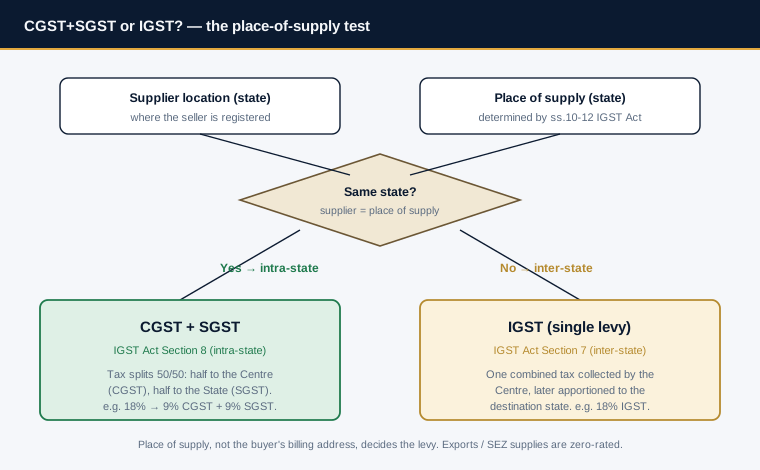
The place of supply decides it. Same state as the supplier is an intra-state supply charged CGST + SGST under Section 8 of the IGST Act[7]; a different state is an inter-state supply charged a single IGST under Section 7[7]. The rate is the same either way, only the heads differ.
GST is levied as three components: CGST under Section 9 of the CGST Act[8], SGST under Section 9 of the matching State GST Act, and IGST under Section 5 of the IGST Act[8]. UTGST replaces SGST in a Union Territory with no legislature. The three never all appear on one supply: it is CGST + SGST together, or IGST alone.
- The most common error is using the buyer's billing address instead of the statutory place of supply under Sections 10-12 of the IGST Act. On a bill-to/ship-to sale of goods, the place of supply is the location of the party billed, not the delivery address.
- A supply to a Special Economic Zone unit is inter-state (IGST, zero-rated) even inside one state, under Section 7(5), IGST Act.
- A wrong split is one of the cleanest ways to fail GSTR reconciliation, because the buyer claims credit under a head you did not charge. If you do charge the wrong head, Section 77 CGST and Section 19 IGST let you reclaim it without interest once you pay the correct one.
| Test result | Supply type | Tax charged | Example at an 18% rate |
|---|---|---|---|
| Supplier state = place of supply | Intra-state (Section 8) | CGST + SGST | 9% CGST + 9% SGST |
| Supplier state ≠ place of supply | Inter-state (Section 7) | IGST (single line) | 18% IGST |
| Place of supply outside India, or to an SEZ | Inter-state, zero-rated | IGST at a nil effective rate | Nil (Section 7(5) read with Section 16, IGST) |
Source: Sections 7 and 8, IGST Act 2017[7]. The 18% figure illustrates one common services rate; apply the rate notified for your specific supply, as CBIC slabs change.
HSN and SAC codes: how many digits, and the UQC unit?
Short answer
An HSN code classifies goods and a SAC code classifies services; the code fixes the GST rate on the line. Notification 78/2020 - Central Tax[9] sets the minimum HSN depth by turnover: 4 digits up to ₹5 crore, 6 digits above ₹5 crore, and 8 for exports and certain notified goods.
- A wrong code carries the wrong rate, so the tax charged does not match the goods; the mismatch surfaces when the seller's return and the buyer's claim are compared, and the buyer's input tax credit can be held up.
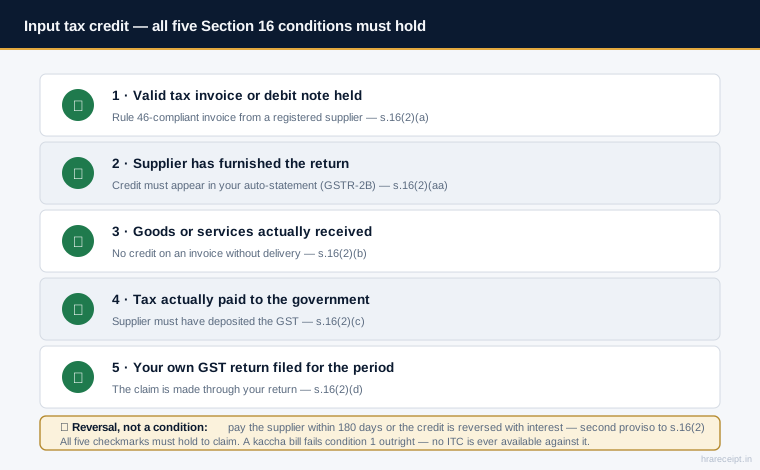
- Do you know? Input tax credit is the GST a buyer already paid on purchases, set off against the GST they collect on sales, and a valid Rule 46 tax invoice is the document that carries it. The second proviso to Section 16(2) of the CGST Act[3] adds a trap: a registered buyer who claims the credit but does not pay the supplier the value plus tax within 180 days of the invoice date must reverse that credit and pay it back with interest under Section 50 (the mechanics are in Rule 37). Pay your suppliers on time, or the credit you booked comes back to bite you.
- If you bill a service, not goods, the line carries a SAC code, not an HSN: a plumber, electrician, freelancer, or consultant classifies the work under the Service Accounting Code series, e.g. 9954 for construction and installation, 9983 for technical and professional services. Putting an HSN on a service line, or vice versa, is a common mismatch that fails GSTR-1 validation. Match the goods or service precisely on the CBIC GST portal and reuse the same code across invoices.
- The unit of measure has its own controlled vocabulary: Rule 46(i) requires the quantity with a standard Unit Quantity Code (UQC). Use NOS for numbers, PCS for pieces, KGS for kilograms, MTR for metres, LTR for litres. Free-text units like "pc" or "nos." fail GSTR-1 and e-invoice validation.
| Situation | Minimum HSN digits |
|---|---|
| Aggregate turnover up to ₹5 crore | 4 digits |
| Aggregate turnover above ₹5 crore | 6 digits |
| Exports, imports, and certain notified goods | 8 digits |
Minimum HSN digits on a GST invoice, per Notification 78/2020[9]. From the January 2025 GSTR-1 period, HSN is picked from a validated dropdown and a mandatory HSN summary table, so a short or made-up code fails at filing. Confirm the current GSTN advisory for the period you file.
B2B vs B2C: how buyer status changes the invoice
Short answer
A B2B supply is to a registered buyer with a GSTIN, and the invoice must carry that GSTIN under Rule 46[2]. A B2C supply is to an unregistered buyer and carries no buyer GSTIN, but a B2C sale of ₹50,000 or more still needs the buyer's name, address, and state under Rule 46(e)-(f).
Do you know? A dynamic UPI QR code on B2C invoices is mandatory only for a registered person above ₹500 crore aggregate turnover, under Notification 14/2020-Central Tax[11] and the sixth proviso to Rule 46. A typical shop or freelancer is well below that line and is under no obligation to print one, though a payment QR is still good practice for getting paid.
- The recipient GSTIN on a B2B invoice is what lets the buyer match the supply in GSTR-2B and claim input tax credit; a wrong or missing one is a frequent reason a registered customer asks for a corrected bill.
- Recording the unregistered buyer's state on a ₹50,000-plus B2C invoice also fixes the place of supply, so it decides whether you charge IGST or CGST/SGST.
- A registered Instagram seller in Maharashtra shipping 40 orders, 35 to consumers and 5 to GST-registered shops, issues 5 full B2B tax invoices (reported invoice-wise) and 35 B2C invoices; a consumer order shipped to Gujarat carries IGST, an intra-Maharashtra order carries CGST + SGST.
| GSTR-1 bucket | What it covers | How it is reported |
|---|---|---|
| B2B | Sales to a registered buyer with a GSTIN | Invoice by invoice, so the buyer gets input tax credit in GSTR-2B |
| B2CL (B2C Large) | Inter-state sales to an unregistered buyer where the invoice value is over ₹1 lakh | Invoice by invoice, with place of supply |
| B2CS (B2C Small) | All other B2C: intra-state, and inter-state at or below ₹1 lakh | Consolidated rate-wise summary per state |
B2CL is the only B2C bucket reported invoice-wise. The ₹1 lakh cut-off was cut from ₹2.5 lakh by Notification 12/2024-Central Tax[10], w.e.f. 1 August 2024. Confirm the current GSTR-1 instructions before filing.
What is not a tax invoice: proforma, quotation, advance receipt
Short answer
A quotation, a proforma invoice, and an advance receipt are all pre-supply documents that carry no GST liability and support no input tax credit. Only a tax invoice under Section 31[1] does, and it must replace them once the supply actually happens.
- A proforma is a commitment-stage estimate: nothing has been supplied, it enters no GST return, and the buyer cannot claim credit against it. The moment the supply happens it is replaced by a Rule 46 tax invoice.
- On receiving an advance you issue a receipt voucher under Section 31(3)(d), with the Rule 50 fields[2]. GST is due on an advance for services when received (Section 13(2)); on an advance for goods, Notification 66/2017 removed that trigger, so the tax waits for the invoice. If the order is cancelled, a refund voucher under Section 31(3)(e) closes it.
- Do you know? A credit or debit note under Section 34, CGST Act[12] is what corrects a tax invoice after issue, and it is always raised by the supplier. A credit note (charged too much) must be declared in a return by 30 November after the supply's financial year under Section 34(2); a debit note (charged too little) has no such deadline. A credit note in your books alone does not reduce your GST: unless it is declared in the GST return, your output-tax liability stands, so a book note is not a GST note.
| Document | When it is issued | GST standing |
|---|---|---|
| Quotation | To propose a price, early in talks | None; purely indicative |
| Proforma invoice | After terms are agreed, before the supply | None; no liability, no input tax credit |
| Advance receipt (receipt voucher) | On receiving money before the supply | Records the advance under Section 31(3)(d); not a tax invoice |
| Tax invoice (pakka bill) | On or after the actual supply | Carries GST; supports the buyer's credit under Section 16 |
Only the tax invoice is the GST document under Section 31, CGST Act[1] and Rule 46[2]. For the wider set, see invoice vs receipt vs quotation.
Invoice mistakes that trigger a Section 122 notice
Short answer
Under Section 122(1) of the CGST Act[5], an incorrect or false invoice draws a penalty of ₹10,000 or the tax involved, whichever is higher, even on a single bill. These are not fraud cases: a clerical slip is enough, and most surface at GSTR-1 reconciliation or audit.
Take a registered wholesaler who sells ₹1,00,000 of taxable goods (18% GST = ₹18,000) and hands over a kaccha slip instead of a tax invoice. The buyer never sees the ₹18,000 in their GSTR-2B, because the seller never reported the invoice in GSTR-1. At a departmental check the ₹1,00,000 sale with no matching invoice reads as suppressed supply.
- On that ₹18,000 of tax, the Section 122(1) penalty is the higher of ₹10,000 or the tax evaded, so ₹18,000, not ₹10,000; the ₹18,000 tax is still payable, now with Section 50[6] interest from the original due date. A ₹1,00,000 kaccha sale can cost roughly ₹18,000 tax + ₹18,000 penalty + interest, against ₹0 had a pakka bill been raised.
- Wrong or missing GSTIN, and a wrong or missing HSN/SAC code, both block the buyer's credit and flag the invoice at GSTR-2B reconciliation.
- Invoice numbers that are not unique and sequential (Rule 46(b)) read as suppression; a pakka bill generator numbers each invoice in one continuous series automatically.
- Claiming input tax credit on Section 17(5)[3] blocked credits, most motor vehicles, food and beverages, and personal-use goods, invites a demand even when the invoice itself is valid.
- A valid invoice is only the first of five Section 16[3] conditions the buyer must clear to claim ITC. The figure below maps all five in order: the invoice must also appear in their GSTR-2B, the goods or services must be received, the supplier must have paid the tax, and the buyer must have filed their own return. An invoice mistake fails the first condition, and the credit stops there.
E-invoicing: does the ₹5 crore threshold apply to you?
Short answer
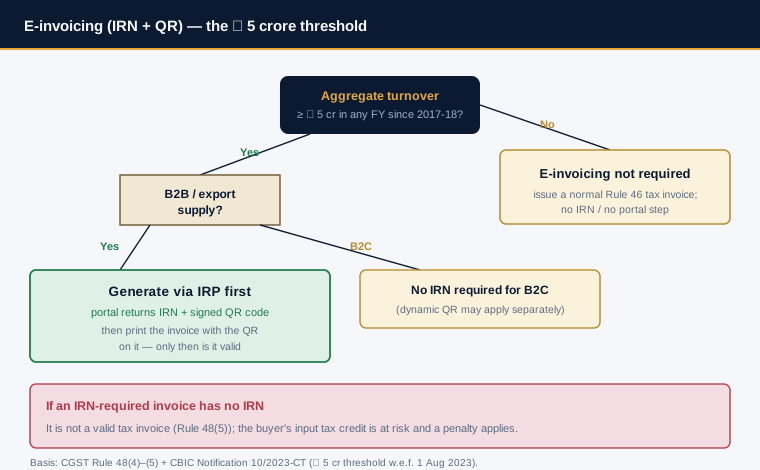
Probably not, unless you are a larger business. E-invoicing is mandatory only where aggregate turnover crossed ₹5 crore in any financial year since 2017-18, under CBIC Notification 10/2023-Central Tax[13]; below that you issue an ordinary Rule 46 tax invoice with no IRN.
- Above ₹5 crore, a covered B2B invoice (also exports, SEZ, and reverse-charge supplies, but not B2C) must be registered on the Invoice Registration Portal (IRP), which returns an Invoice Reference Number (IRN), a 64-character hash, and a signed QR code to print on the bill. Your billing software still creates the invoice; the IRP only registers it.
- An invoice that needed an IRN but does not carry one is not a valid tax invoice under Rule 48(5), so the buyer loses input tax credit and the seller faces a penalty. A kaccha slip cannot carry an IRN at all.
- Some classes are exempt from e-invoicing even above ₹5 crore: banks, NBFCs and other financial institutions, insurers, goods transport agencies, passenger-transport operators, and cinemas or multiplexes need not generate an IRN whatever their turnover, under the Rule 48(4) exemption notifications.
- An e-invoice IRN is not an e-way bill. They are separate documents: the IRN registers the invoice, the e-way bill covers the movement of goods above the value threshold. Generating an e-invoice does not remove the e-way-bill requirement, though the portal can create the e-way bill from the same data.
- A separate 30-day reporting window applies at ₹10 crore-plus turnover: from 1 April 2025, each invoice, credit note, and debit note must reach the IRP within 30 days of its date, per the GSTN advisory of 5 November 2024[14]; miss it and the portal blocks the IRN.
- The ₹5 crore figure is year-variable: the GST Council has discussed ₹2 crore, but as of FY 2026-27 nothing lower is notified. Check the CBIC notifications page[13] before assuming you are outside it.
How do you switch from a kaccha bill to a pakka bill?
Short answer
Register for GST if you are over the threshold, then issue a Rule 46[2] tax invoice on every taxable sale instead of a rough slip. Four steps:
- Check whether you must register. Section 22 of the CGST Act[15] makes registration mandatory over the turnover threshold (broadly ₹40 lakh for goods, ₹20 lakh for services, lower in special-category states, per Notification 10/2019-CT). Section 24 also forces it regardless of turnover if you sell inter-state or through an e-commerce platform.
- Get your GSTIN. Register on the GST portal and obtain your 15-character GSTIN. Every pakka bill must print it.
- Raise a Rule 46 tax invoice. Replace the rough slip with an invoice carrying all the Rule 46 fields: GSTIN, a consecutive invoice number, HSN/SAC, the CGST/SGST or IGST split, and the place of supply.
- Report it in GSTR-1. File each B2B invoice in GSTR-1 so it flows into the buyer's GSTR-2B and they can claim the input tax credit. This is the step a kaccha bill skips, and the step an audit checks.
Why a legally clean invoice gets you paid faster
Short answer
A client's accounts team can only process and claim input tax credit on a valid tax invoice, so a missing field or a wrong GSTIN is the most common reason a payment is queried and held. Under Section 16[3], their credit rides on your invoice being clean.
- For a supply of services, Section 31(2) read with Rule 47[2] sets a time limit, generally within 30 days of the supply. Invoicing promptly starts the client's payment clock.
- A clean tax invoice clears the accounts check on the first pass, the practical difference between a payment that moves and one that sits in a query queue.
- A pakka bill generator fills every Rule 46 field and numbers the invoice in sequence, so the document is binding and query-proof from the first download.
| Field | Why the client checks it | What a gap costs you |
|---|---|---|
| Your GSTIN | They match it to claim input tax credit | Invoice rejected; payment held until corrected |
| Their GSTIN | Their credit is keyed to it | Credit blocked at their end; invoice returned |
| Tax split (CGST/SGST or IGST) | It must match the place of supply | A query, and a reissue if the split is wrong |
| Place of supply | It decides which tax is correct | A mismatch with the tax split stalls approval |
| Invoice number + date | They log it against the purchase order | A duplicate or odd date triggers a manual review |
The fields a buyer's accounts team reconciles before releasing payment. Each maps to a Rule 46[2] requirement, so legal validity and fast payment are the same checklist.
References
- 1.Section 31, Central Goods and Services Tax Act 2017 — CBIC — Requirement to issue a tax invoice for a taxable supply; receipt voucher (31(3)(d)) and refund voucher (31(3)(e)) on advances.
- 2.Rule 46, Central Goods and Services Tax Rules 2017 — CBIC — Mandatory particulars of a GST tax invoice, clauses (a) to (s), including the invoice-number rule 46(b), HSN/SAC 46(g), and the ₹50,000 unregistered-buyer rule 46(e)-(f).
- 3.Section 16, Central Goods and Services Tax Act 2017 — India Code — Conditions for input tax credit: possession of a valid tax invoice, the Section 16(2) second-proviso 180-day payment rule, the Section 16(4) time limit (amended to 30 November by the Finance Act 2022), and Section 17(5) blocked credits.
- 4.Rule 49 / Section 31(3)(c), CGST — CBIC — Bill of supply: the correct document for unregistered, composition, or exempt suppliers.
- 5.Section 122, Central Goods and Services Tax Act 2017 — CBIC tax repository — Penalty of ₹10,000 or the tax involved, whichever is higher, for supplying without an invoice or issuing an incorrect one.
- 6.Section 50, Central Goods and Services Tax Act 2017 — CBIC — Interest on tax not paid or short-paid on an unbilled supply.
- 7.Sections 7-8, Integrated Goods and Services Tax Act 2017 — India Code — Inter-state (Section 7, IGST) versus intra-state (Section 8, CGST+SGST) supply; place of supply Sections 10-12.
- 8.Section 5, IGST Act 2017 and Section 9, CGST Act 2017 (the levy) — India Code — CGST levied under Section 9 CGST Act; IGST under Section 5 IGST Act; SGST under Section 9 of the State GST Act.
- 9.Notification 78/2020 - Central Tax (HSN digit depth) — CBIC — 4 HSN digits up to ₹5 crore turnover, 6 digits above ₹5 crore, 8 for exports and notified goods; effective 1 April 2021.
- 10.Notification 12/2024 - Central Tax (B2CL reporting) — GST Council — GSTR-1 B2CL inter-state reporting threshold cut from ₹2.5 lakh to ₹1 lakh, w.e.f. 1 August 2024.
- 11.Notification 14/2020 - Central Tax (B2C dynamic QR) — CBIC — Dynamic UPI QR code on B2C invoices mandatory only above ₹500 crore aggregate turnover.
- 12.Section 34, CGST Act 2017 (credit and debit notes) — India Code — Supplier issues a credit note (34(1)) or debit note (34(3)); credit-note declaration deadline under 34(2).
- 13.CBIC Notification 10/2023 - Central Tax (₹5 crore e-invoicing threshold) — CBIC — E-invoicing mandatory for aggregate turnover above ₹5 crore in any year since 2017-18, w.e.f. 1 August 2023; Rule 48(4)/(5).
- 14.GSTN Advisory: 30-day e-invoice reporting limit (AATO ₹10 crore+, eff. 1 April 2025) — IRN generation blocked for invoices, credit and debit notes reported beyond 30 days from the document date.
- 15.Section 22 and Section 24, CGST Act 2017 (registration thresholds) — India Code — Turnover thresholds for mandatory registration; Section 24 compulsory registration regardless of turnover.
- 16.Search Taxpayer (GSTIN verification) — GST portal, GSTN — Official tool to verify a GSTIN and its registration status before relying on an invoice for input tax credit.
- 17.Rule 46, CGST Rules 2017 (live consolidated text, clause (s)) — CBIC tax repository — Current Rule 46 including clause (s), the non-e-invoice declaration, inserted by Notification 14/2022-Central Tax w.e.f. 5 July 2022.
References & related
Primary sources
- Section 31, Central Goods and Services Tax Act 2017 — CBICRequirement to issue a tax invoice for a taxable supply; receipt voucher (31(3)(d)) and refund voucher (31(3)(e)) on advances.
- Rule 46, Central Goods and Services Tax Rules 2017 — CBICMandatory particulars of a GST tax invoice, clauses (a) to (s), including the invoice-number rule 46(b), HSN/SAC 46(g), and the ₹50,000 unregistered-buyer rule 46(e)-(f).
- Section 16, Central Goods and Services Tax Act 2017 — India CodeConditions for input tax credit: possession of a valid tax invoice, the Section 16(2) second-proviso 180-day payment rule, the Section 16(4) time limit (amended to 30 November by the Finance Act 2022), and Section 17(5) blocked credits.
- Rule 49 / Section 31(3)(c), CGST — CBICBill of supply: the correct document for unregistered, composition, or exempt suppliers.
- Section 122, Central Goods and Services Tax Act 2017 — CBIC tax repositoryPenalty of ₹10,000 or the tax involved, whichever is higher, for supplying without an invoice or issuing an incorrect one.
- Section 50, Central Goods and Services Tax Act 2017 — CBICInterest on tax not paid or short-paid on an unbilled supply.
- Sections 7-8, Integrated Goods and Services Tax Act 2017 — India CodeInter-state (Section 7, IGST) versus intra-state (Section 8, CGST+SGST) supply; place of supply Sections 10-12.
- Section 5, IGST Act 2017 and Section 9, CGST Act 2017 (the levy) — India CodeCGST levied under Section 9 CGST Act; IGST under Section 5 IGST Act; SGST under Section 9 of the State GST Act.
- Notification 78/2020 - Central Tax (HSN digit depth) — CBIC4 HSN digits up to ₹5 crore turnover, 6 digits above ₹5 crore, 8 for exports and notified goods; effective 1 April 2021.
- Notification 12/2024 - Central Tax (B2CL reporting) — GST CouncilGSTR-1 B2CL inter-state reporting threshold cut from ₹2.5 lakh to ₹1 lakh, w.e.f. 1 August 2024.
- Notification 14/2020 - Central Tax (B2C dynamic QR) — CBICDynamic UPI QR code on B2C invoices mandatory only above ₹500 crore aggregate turnover.
- Section 34, CGST Act 2017 (credit and debit notes) — India CodeSupplier issues a credit note (34(1)) or debit note (34(3)); credit-note declaration deadline under 34(2).
- CBIC Notification 10/2023 - Central Tax (₹5 crore e-invoicing threshold) — CBICE-invoicing mandatory for aggregate turnover above ₹5 crore in any year since 2017-18, w.e.f. 1 August 2023; Rule 48(4)/(5).
- GSTN Advisory: 30-day e-invoice reporting limit (AATO ₹10 crore+, eff. 1 April 2025)IRN generation blocked for invoices, credit and debit notes reported beyond 30 days from the document date.
- Section 22 and Section 24, CGST Act 2017 (registration thresholds) — India CodeTurnover thresholds for mandatory registration; Section 24 compulsory registration regardless of turnover.
- Search Taxpayer (GSTIN verification) — GST portal, GSTNOfficial tool to verify a GSTIN and its registration status before relying on an invoice for input tax credit.
- Rule 46, CGST Rules 2017 (live consolidated text, clause (s)) — CBIC tax repositoryCurrent Rule 46 including clause (s), the non-e-invoice declaration, inserted by Notification 14/2022-Central Tax w.e.f. 5 July 2022.