GST · 17 June 2026
What Fields Must a GST Tax Invoice Carry Under Section 31 and Rule 46?
Section 31 of the CGST Act makes it compulsory for a registered supplier to issue a tax invoice on every taxable supply. Rule 46 of the CGST Rules lists the exact particulars that invoice must carry. Any document missing those fields is not a valid tax invoice, and the buyer cannot claim input tax credit under Section 16.
By Mrs. Swapna Patel
Published on 17 June 2026
Last modified on 22 July 2026
In this section
Answers
- What Fields Must a GST Tax Invoice Carry Under Section 31 and Rule 46?
- What Must You Verify Before Submitting Your ITR for AY 2026-27?
- What Is GSTR-1, the GST Return of Outward Supplies?
- What Is GSTR-3B, the Monthly GST Summary Return?
- What Is the Time of Supply Under GST, and When Does Tax Become Due?
- Advance Receipt Under GST: When Do You Issue a Receipt Voucher?
- Credit Note vs Debit Note Under GST: When Do You Issue Each?
- What Is GSTR-2B, and Why Does It Now Decide Your Input Tax Credit?
- What Is the Value of Supply Under Section 15 of the CGST Act?
- What Are the GST Rate Slabs in India After the GST 2.0 Reform?
Any document that shows a total and a GST number qualifies as a tax invoice for input tax credit.
A GST tax invoice must carry every field Rule 46 prescribes. One missing particular voids the ITC claim under Section 16.
What makes a document a valid GST tax invoice?
Short answer
Section 31 of the CGST Act[1] requires every registered supplier making a taxable supply to issue a tax invoice. Rule 46 of the CGST Rules[2] fixes the particulars it must carry. A document that omits any of those fields is not a valid tax invoice.
- The obligation to issue sits with the supplier: Section 31 does not give the seller a choice on taxable supplies.
- Rule 46 is an exhaustive list. Every clause is a hard statutory requirement.
- The buyer bears the downstream risk: Section 16[3] permits input tax credit only against a valid tax invoice. If the invoice fails Rule 46, the credit is disallowed.
- Composition suppliers and suppliers of exempt goods issue a bill of supply under Rule 49. Tax invoice rules do not apply to them.
Rule 46 field list: every mandatory particular
Short answer
Rule 46[2] lists nineteen particulars, clauses (a) to (s), grouped into four blocks: supplier, recipient, line items, and tax. Several clauses are conditional: recipient details differ for a registered versus an unregistered buyer, place of supply applies inter-State, a reverse-charge flag is required, clause (r) adds an IRN QR code only on e-invoices, and clause (s) is a declaration required where a turnover-eligible supplier is exempt from issuing an e-invoice.
| Rule 46 clause | Field | Notes |
|---|---|---|
| 46(a) | Supplier's name, address, GSTIN | GSTIN is mandatory. Name and address must match the GST registration. |
| 46(b) | Consecutive invoice number | Up to 16 characters; must be unique for the financial year; serial breaks are an audit flag. |
| 46(c) | Invoice date | Date of supply or date of issue, whichever applies under the time-of-supply rules. |
| 46(d) | Recipient's name, address, GSTIN | Mandatory when the buyer is registered. |
| 46(e)–46(f) | Unregistered buyer details | If the buyer is unregistered and the value is ₹50,000 or more, name, address, and state are required; below ₹50,000 only on request. |
| 46(g) | HSN code (goods) or SAC code (services) | HSN digits required depend on annual turnover tier; SAC for every service line. |
| 46(h) | Description of goods or services | Must name the goods or service, not just a category code. |
| 46(i) | Quantity and unit of measure | For goods; not applicable for pure-service invoices. |
| 46(j) | Total value of supply | Gross value of the goods or services supplied. |
| 46(k) | Taxable value | Value of supply after any discount, net of GST. |
| 46(l)–46(m) | GST rate and tax amount | Split into CGST + SGST for intra-state; IGST for inter-state. Show rate and rupee amount. |
| 46(n) | Place of supply + state name | Required on inter-state supplies; determines whether IGST or CGST/SGST applies. |
| 46(o) | Place of delivery (if different) | Relevant where the delivery address differs from the billing address. |
| 46(p) | Whether tax is on reverse charge | Flag must appear even when the answer is "No". Absence is a compliance gap. |
| 46(q) | Signature or digital signature | Of the supplier or an authorised signatory. Required on every invoice. |
| 46(r) | QR code with embedded IRN | Required only where the invoice is issued as an e-invoice under Rule 48(4). |
| 46(s) | Declaration (non-e-invoice) | Required where a supplier whose turnover crosses the e-invoice threshold nonetheless issues a normal tax invoice because it is exempt from e-invoicing under Rule 48(4). |
Source: Rule 46, CGST Rules 2017[2] (consolidated). The rows enumerate clauses (a) to (s). The last two hinge on e-invoicing status: clause (r), the IRN QR code, applies where an e-invoice is issued under Rule 48(4); clause (s), a declaration, applies where a turnover-eligible supplier is exempt from e-invoicing and issues a normal invoice instead. Clause letters follow the consolidated rule; HSN digit requirements vary by turnover tier per CBIC notification, so check your registration tier before finalising your template.
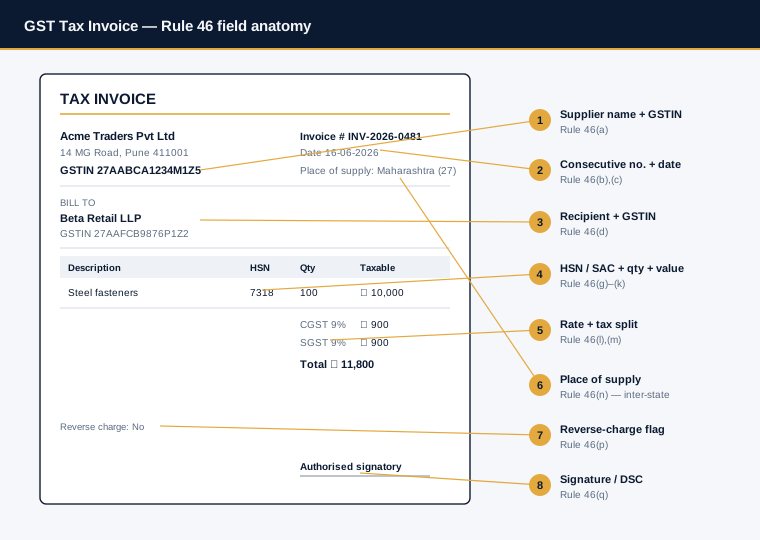
Which fields change for an unregistered buyer?
Short answer
When the buyer is unregistered and the invoice value exceeds ₹50,000, Rule 46(d) requires the buyer's name, address, and state. Below that threshold, those fields may be omitted.
- The ₹50,000 threshold applies per invoice, not per transaction series. A single invoice above the limit triggers the full recipient-detail requirement.
- For B2C supplies below ₹50,000 to unregistered buyers, the invoice can show "Unregistered" in the GSTIN field; the other recipient fields are optional.
- E-invoicing under the IRP (Invoice Registration Portal) requires the GSTIN field to be populated when both parties are registered; the portal rejects a blank GSTIN for a B2B transaction.
- See pakka bill vs kaccha bill for how the registered/unregistered distinction drives the choice between a tax invoice and a bill of supply.
What happens if a field is missing?
Short answer
A tax invoice missing a Rule 46 field is not a valid tax invoice. The buyer's input tax credit claim under Section 16 is at risk.
- GST officers can disallow ITC at audit if the invoice presented does not carry all Rule 46 particulars.
- A gap in the invoice number sequence surfaces in GSTR-1 reconciliation; GST officers read it as a suppression signal.
- A missing reverse-charge flag on Rule 46(p) is itself a compliance gap, even when the actual liability is zero.
- For high-turnover suppliers above ₹5 crore from FY 2024-25, e-invoicing through the IRP validates Rule 46 fields before issuing an Invoice Reference Number (IRN). A document without an IRN is not a valid tax invoice for those suppliers.
- A pakka bill generator fills every Rule 46 field automatically, so the invoice carries the full field set from the first download.
References
- 1.Section 31, Central Goods and Services Tax Act 2017 — CBIC — Statutory requirement to issue a tax invoice on a taxable supply.
- 2.Rule 46, Central Goods and Services Tax Rules 2017 — CBIC — Mandatory particulars of a GST tax invoice.
- 3.Section 16, Central Goods and Services Tax Act 2017 — CBIC — Input tax credit conditions, including possession of a valid tax invoice.
- 4.Rule 49 / Section 31(3)(c), CGST — CBIC — Bill of supply: correct document for composition, exempt, or unregistered suppliers.
References & related
Primary sources
- Section 31, Central Goods and Services Tax Act 2017 — CBICStatutory requirement to issue a tax invoice on a taxable supply.
- Rule 46, Central Goods and Services Tax Rules 2017 — CBICMandatory particulars of a GST tax invoice.
- Section 16, Central Goods and Services Tax Act 2017 — CBICInput tax credit conditions, including possession of a valid tax invoice.
- Rule 49 / Section 31(3)(c), CGST — CBICBill of supply: correct document for composition, exempt, or unregistered suppliers.