Tax Guide · 15 May 2026
Bill of Supply: Composition or Unregistered, Which Do You Issue?
Rule 49 of the CGST Rules 2017 requires a Bill of Supply (not a tax invoice) when GST is not collected on the supply, either because the supplier is below the GST registration threshold (Rs. 40 lakh goods / Rs. 20 lakh services) or because the supplier is on the Composition scheme under Section 10. Composition-scheme BoS must carry the Rule 5(1)(f) declaration ("Composition taxable person, not eligible to collect tax on supplies"); unregistered-seller BoS carries the supplier's PAN in place of a GSTIN. Buyers cannot claim Input Tax Credit against either variant; that is the defining difference from a pakka bill.
By Mrs. Swapna Patel
Published on 15 May 2026
Last modified on 25 June 2026
By Mrs. Swapna Patel
Published 15 May 2026
Updated 25 June 2026
In this section
Answers
- Bill of Supply: Composition or Unregistered, Which Do You Issue?
- What does a ₹1 revenue stamp on a rent receipt actually prove?
- What turnover thresholds make GST registration mandatory in 2026?
- GSTR-1, GSTR-2B and GSTR-3B: Which GST Return Is Which, and How?
- What Must You Verify Before Submitting Your ITR for AY 2026-27?
- What Is the Time of Supply Under GST, and When Does Tax Become Due?
- What Is the Value of Supply Under Section 15 of the CGST Act?
- What Are the GST Rate Slabs in India After the GST 2.0 Reform?
- Exempt vs Nil-Rated vs Zero-Rated Supply: What Is the Difference?
- Composite vs Mixed Supply Under Section 8: Which GST Rate Applies?
A Bill of Supply can replace a tax invoice on any sale to keep paperwork simple.
A registered person making taxable supplies above Rs. 50,000 must issue a tax invoice under Section 31[1]; a BoS issued in its place invalidates the buyer's Input Tax Credit.
Who has to issue a Bill of Supply instead of a tax invoice?
Short answer
Any supplier who does not collect GST on the supply issues a Bill of Supply under Rule 49 of the CGST Rules 2017[2], not a tax invoice.
- Composition-scheme registrants under Section 10[3] issue a BoS because they cannot collect GST from buyers.
- Suppliers below the registration threshold under Section 23[4] issue a BoS because they have no GSTIN to collect GST against.
- Registered suppliers issuing exempt-supply lines under Section 31(3)(c) issue a BoS for those lines.
- The buyer-side consequence is identical across all three: no Input Tax Credit, so the GST element stays on the buyer's P&L.
What is the difference between the composition variant and the unregistered variant?
Short answer
The composition BoS shows a GSTIN plus the mandatory Rule 5(1)(f)[5] declaration; the unregistered BoS shows the supplier's PAN in place of a GSTIN.
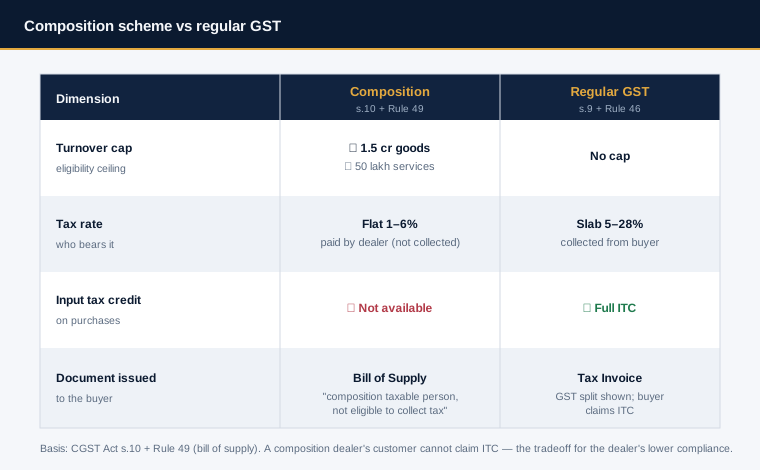
The composition variant is a registered dealer under Section 10[3] who pays a flat 1% (traders), 5% (restaurants), or 6% (services) turnover tax out of pocket; the unregistered variant is a seller below the threshold who pays nothing. Both hand the buyer a document that carries no GST and no input tax credit, which is the line that separates either from a regular tax invoice.
| Axis | Composition (Section 10) | Unregistered (Section 23) |
|---|---|---|
| Statutory basis | Section 10 composition scheme | Section 23, below registration threshold |
| Identifier on document | GSTIN | PAN in place of GSTIN |
| Supplier GST cost | Flat turnover tax: 1% traders, 5% restaurants without alcohol, 6% services | None; outside the GST net |
| Rule 5(1)(f) declaration | Mandatory verbatim | Not applicable |
| Buyer Input Tax Credit | Zero | Zero |
Composition vs unregistered Bill of Supply. Source: Section 10 + Section 23, CGST Act 2017 and Rule 49, CGST Rules 2017.
What are the turnover thresholds for each variant?
Short answer
Composition under Section 10[3] runs up to Rs. 1.5 crore aggregate turnover (Rs. 75 lakh in special-category states); the unregistered route under Section 23[4] applies below Rs. 40 lakh for goods or Rs. 20 lakh for services.
- Exclusive suppliers of goods stay outside registration below Rs. 40 lakh aggregate turnover.
- Service suppliers and mixed suppliers stay outside registration below Rs. 20 lakh.
- The composition scheme caps eligibility at Rs. 1.5 crore aggregate turnover, or Rs. 75 lakh in special-category states.
- A supplier crossing the threshold mid-year switches variant: to composition if they elect Section 10, or to a pakka bill if they register as a regular taxpayer.
What does Rule 49 require on the document, field by field?
Short answer
Rule 49 of the CGST Rules 2017[2] lists eight mandatory fields; a BoS missing any one is technically deficient and can be questioned at audit.
- Name, address, and GSTIN of the supplier (or PAN, where unregistered).
- A consecutive serial number, maximum 16 characters, unique per financial year; a slash or hyphen counts toward the 16-character limit.
- Date of issue, plus name, address, and GSTIN of the recipient (GSTIN mandatory only if the recipient is registered).
- HSN for goods or SAC for services; four-digit HSN is acceptable below the Rs. 5 crore turnover threshold.
- Description of goods or services, and value of supply net of discount or abatement.
- Signature or digital signature of the supplier or authorised representative.
What exactly is the Rule 5(1)(f) declaration and when is it required?
Short answer
On every composition-scheme BoS the Rule 5(1)(f)[5] declaration "Composition taxable person, not eligible to collect tax on supplies" is mandatory verbatim, regardless of supply value.
- The declaration sits separately from the eight mandatory Rule 49 fields, prescribed instead by Rule 5(1)(f) of the CGST Rules.
- It appears only on the composition variant; the unregistered variant carries no such declaration.
- Its absence is the single most common defect flagged in composition-scheme audits, independent of any tax question.
- On our generator the declaration text is editable with a reset-to-statutory-default control, so wording adjusts without losing the canonical Rule 5(1)(f) language.
When does a Bill of Supply NOT replace a tax invoice?
Short answer
A registered person making taxable supplies above Rs. 50,000 must issue a pakka bill under Section 31[1], not a BoS.
- A registered supplier issuing a BoS in place of a tax invoice invalidates the buyer's ITC and risks disallowance with interest and penalty under Section 122.
- A composition supplier who charges GST on a tax invoice breaches Rule 5(g), must remit the GST, and may lose composition eligibility under Section 10 for the year.
- An unregistered supplier labelling a document "tax invoice" with GST commits a Section 32 violation; with no GSTIN, the recipient cannot match ITC in GSTR-2B.
- For the registered taxable case use the pakka bill generator; for the broader question see invoice vs receipt vs quotation.
Which Bill of Supply errors trigger audit scrutiny?
Short answer
Five recurring defects attract scrutiny disproportionate to their severity, led by the missing Rule 5(1)(f)[5] declaration on composition documents.
- Missing serial number: Rule 49 with Rule 46(b) requires a unique consecutive serial per financial year, maximum 16 characters; absence invalidates the document.
- Missing composition declaration on the composition variant: the most common single defect in audit data.
- Wrong-format date: DD-MM-YYYY and ISO YYYY-MM-DD are both accepted, but mixing formats is the visible flag.
- Charging tax on a BoS: the recipient gets no ITC since the BoS does not feed GSTR-2B; the supplier owes the amount under Section 76 plus a Section 31 violation.
- Missing HSN or SAC: Rule 49 with Rule 46(g) is explicit; four-digit HSN is acceptable below Rs. 5 crore turnover, else the supply cannot be reconciled against the tariff.
How do I generate a compliant Bill of Supply?
Short answer
Use the Bill of Supply generator: a four-step form keeps the Rule 49[2] layout intact, the PDF is built in-browser, and a clean copy is Rs. 4.
- A pre-form GST-status router asks two yes/no questions, then selects pakka-bill, composition, or unregistered, with manual override.
- The four steps are Bill details, Parties, Items, and Preview, where the Preview renders the PDF with all eight Rule 49 fields populated.
- On the composition variant the Rule 5(1)(f) declaration loads by default, editable with a reset-to-statutory-default control; overrides are logged in metadata.
- Payment is Rs. 4 via Razorpay or 1 credit per BoS under the corporate plan; the PDF is built in-browser, so no row data leaves the browser. The free draft lets you proofread before paying.
- For batches, the bulk-Excel mode accepts up to 500 BoS per upload, the variant column gating which fields validate per row.
References
- 1.Section 31, CGST Act 2017 — CBIC — Tax invoice + Bill of Supply statutory basis
- 2.Rule 49, CGST Rules 2017 — CBIC — Bill of Supply format + mandatory fields
- 3.Section 10, CGST Act 2017 — Composition scheme — Composition-scheme statutory basis
- 4.Section 23, CGST Act 2017 — Registration threshold — Who is not liable for GST registration
- 5.Rule 5, CGST Rules 2017 (composition conditions) — CBIC — Rule 5(1)(f): the mandatory composition declaration on every bill of supply
References & related
Primary sources
- Section 31, CGST Act 2017 — CBICTax invoice + Bill of Supply statutory basis
- Rule 49, CGST Rules 2017 — CBICBill of Supply format + mandatory fields
- Section 10, CGST Act 2017 — Composition schemeComposition-scheme statutory basis
- Section 23, CGST Act 2017 — Registration thresholdWho is not liable for GST registration
- Rule 5, CGST Rules 2017 (composition conditions) — CBICRule 5(1)(f): the mandatory composition declaration on every bill of supply