GST · 25 June 2026
What Is the Reverse Charge Mechanism (RCM) in GST?
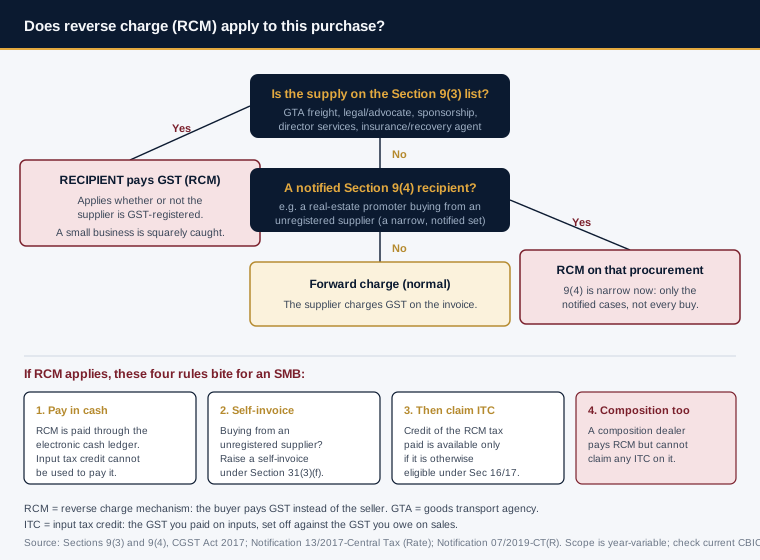
The reverse charge mechanism (RCM) reverses the normal GST flow: the recipient of a supply pays the tax to the government instead of the supplier charging it on the invoice. It applies in three statutory cases: Section 9(3) of the CGST Act, a notified list of supplies such as goods transport, legal and director services; Section 9(4), where a notified registered recipient buys from an unregistered supplier; and Section 5(3) of the IGST Act, which applies the same logic to inter-state and imported supplies. The recipient pays RCM in cash, cannot set it off with existing input tax credit, and must raise a self-invoice under Section 31(3)(f) when the supplier is unregistered. The liability sits with the recipient, so an unpaid RCM amount is the buyer's default, not the supplier's.
By Mrs. Swapna Patel
Published on 25 June 2026
Last modified on 25 June 2026
In this section
Answers
- What Is the Reverse Charge Mechanism (RCM) in GST?
- What Must You Verify Before Submitting Your ITR for AY 2026-27?
- What Is GSTR-1, the GST Return of Outward Supplies?
- What Is GSTR-3B, the Monthly GST Summary Return?
- What Is the Time of Supply Under GST, and When Does Tax Become Due?
- Advance Receipt Under GST: When Do You Issue a Receipt Voucher?
- Credit Note vs Debit Note Under GST: When Do You Issue Each?
- What Is GSTR-2B, and Why Does It Now Decide Your Input Tax Credit?
- What Is the Value of Supply Under Section 15 of the CGST Act?
- What Are the GST Rate Slabs in India After the GST 2.0 Reform?
The supplier always charges and pays the GST, so the buyer can never be the one liable for it.
Under the reverse charge mechanism, Section 9(3) and 9(4) of the CGST Act[1] make the recipient pay GST directly to the government on notified supplies, instead of the supplier collecting it.
What does the reverse charge mechanism mean?
Short answer
It flips the normal rule: under Section 9(3) and 9(4) of the CGST Act[1], the recipient pays GST to the government, instead of the supplier charging it on the bill (forward charge).
Normally the supplier adds GST to the invoice, collects it from you, and pays it to the government. That is forward charge. Reverse charge moves that duty to the recipient, who computes the tax, pays it, and reports it in their own returns.
- Forward charge (the default): supplier charges GST, the buyer pays the supplier, the supplier pays the government.
- Reverse charge (RCM): the supplier charges no GST; the recipient pays it to the government directly and reports it in GSTR-3B.
- Why it matters: under RCM the unpaid-tax default is the recipient's, not the supplier's, so the tax, interest and penalty land on the buyer.
When does GST move to reverse charge?
Short answer
In three notified cases: Section 9(3)[1] (a fixed list of supplies), Section 9(4)[1] (notified recipient buying from an unregistered supplier), and Section 5(3) of the IGST Act[2] (inter-state and import equivalents).
| Provision | Trigger | Who pays GST |
|---|---|---|
| Section 9(3), CGST Act | A supply on the notified list (Notification 13/2017): GTA freight, advocate or legal services, sponsorship, director services, insurance agent, recovery agent | The recipient, regardless of the supplier being registered |
| Section 9(4), CGST Act | A notified registered recipient buys from an unregistered supplier (now narrow, mainly real-estate promoters) | The registered recipient |
| Section 5(3), IGST Act | The same notified supplies, but inter-state, plus import of services | The recipient, on the inter-state / import supply |
Source: Section 9, CGST Act[1], Section 5(3), IGST Act[2], and Notification 13/2017-CT(R)[3]. The notified list is amended from time to time; check the current CBIC notification before relying on any single row.
How does the recipient pay and account for RCM?
Short answer
The recipient pays RCM in cash through the electronic cash ledger, because RCM tax is not "output tax" under Section 2(82)[5], so input tax credit cannot discharge it and Rule 85(4) requires the cash ledger; the recipient also raises a self-invoice under Section 31(3)(f)[4] when the supplier is unregistered.
- Pay in cash: RCM cannot be set off with accumulated input tax credit; it is a real cash outflow in the month of liability.
- Then claim it back: once paid, the RCM amount becomes input tax credit under Section 16, but only if the supply is otherwise eligible and not blocked under Section 17.
- Self-invoice the unregistered supplier: because the supplier issues no invoice, the recipient raises one under Section 31(3)(f) to support the credit.
- Why it matters: a missing self-invoice is itself a compliance gap, even when the tax has been paid.
How is RCM different from the normal tax invoice flow?
Short answer
Under forward charge the supplier issues a tax invoice and you claim credit against it; under RCM you issue your own self-invoice, pay the tax in cash, and the document trail starts with you, not the supplier.
- Document: forward charge starts from the supplier's Rule 46 tax invoice; RCM from an unregistered supplier starts from your self-invoice.
- Cash flow: forward-charge GST is paid to the supplier; RCM is paid straight to the government from your cash ledger.
- For the small-business view of which freight bills and professional fees trigger RCM, and the composition-dealer trap, see GST reverse charge for a small business.
- A pakka bill generator fills every required field on a tax invoice or self-invoice, so the RCM document trail is audit-ready from the first download.
References
- 1.Section 9, Central Goods and Services Tax Act 2017 (reverse charge) — India Code — Section 9(3) notified reverse-charge supplies; Section 9(4) registered recipient buying from an unregistered supplier.
- 2.Section 5(3), Integrated Goods and Services Tax Act 2017 — India Code — Reverse charge on inter-state and imported supplies, mirroring Section 9(3) CGST.
- 3.Notification 13/2017-Central Tax (Rate) — CBIC — The notified list of services taxed under reverse charge, including GTA, legal, sponsorship and director services.
- 4.Section 31(3)(f), CGST Act 2017 (self-invoice) — India Code — The recipient must raise a self-invoice on an RCM supply received from an unregistered person.
- 5.Section 2(82), CGST Act 2017 (definition of output tax) — India Code — RCM tax is not "output tax" under Section 2(82), so it cannot be set off from input tax credit; the liability is paid from the electronic cash ledger under Rule 85(4).
References & related
Primary sources
- Section 9, Central Goods and Services Tax Act 2017 (reverse charge) — India CodeSection 9(3) notified reverse-charge supplies; Section 9(4) registered recipient buying from an unregistered supplier.
- Section 5(3), Integrated Goods and Services Tax Act 2017 — India CodeReverse charge on inter-state and imported supplies, mirroring Section 9(3) CGST.
- Notification 13/2017-Central Tax (Rate) — CBICThe notified list of services taxed under reverse charge, including GTA, legal, sponsorship and director services.
- Section 31(3)(f), CGST Act 2017 (self-invoice) — India CodeThe recipient must raise a self-invoice on an RCM supply received from an unregistered person.
- Section 2(82), CGST Act 2017 (definition of output tax) — India CodeRCM tax is not "output tax" under Section 2(82), so it cannot be set off from input tax credit; the liability is paid from the electronic cash ledger under Rule 85(4).