Tax Guide · 1 May 2026
Rule 114B: Is PAN Required for a Rs. 50,000 Cash Deposit, or Form 60?
A cash deposit above ₹50,000 in a single day at a bank needs PAN quoted under Rule 114B of the Income Tax Rules, 1962 (Rule 159 of the Income Tax Rules, 2026 from 1 April 2026); without PAN, the bank accepts Form 60. The same rule covers 18 transaction categories in all: time deposits above ₹50,000, cash payments to dealers above ₹2,00,000, immovable property above ₹10,00,000, and others. Form 60 (renumbered Form 97 from 1 April 2026) is the prescribed substitute under sub-rule (5) where PAN is not held.
By Mr. Govind Dhawale
Published on 1 May 2026
Last modified on 1 August 2026
By Mr. Govind Dhawale
Published 1 May 2026
Updated 1 August 2026
In this section
Answers
- Rule 114B: Is PAN Required for a Rs. 50,000 Cash Deposit, or Form 60?
- What does a ₹1 revenue stamp on a rent receipt actually prove?
- What turnover thresholds make GST registration mandatory in 2026?
- GSTR-1, GSTR-2B and GSTR-3B: Which GST Return Is Which, and How?
- What Must You Verify Before Submitting Your ITR for AY 2026-27?
- What Is the Time of Supply Under GST, and When Does Tax Become Due?
- What Is the Value of Supply Under Section 15 of the CGST Act?
- What Are the GST Rate Slabs in India After the GST 2.0 Reform?
- Exempt vs Nil-Rated vs Zero-Rated Supply: What Is the Difference?
- Composite vs Mixed Supply Under Section 8: Which GST Rate Applies?
PAN is only needed on the income tax return, not on individual receipts or payments.
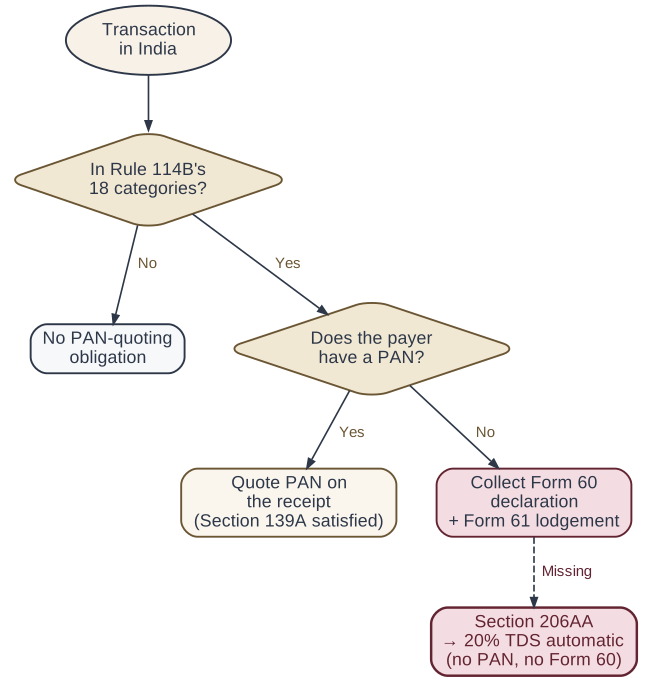
Rule 114B[1] mandates quoting PAN at the point of transaction across 18 categories, and missing it triggers a flat 20% TDS under Section 206AA[2].
TL;DR
Rule 114B (Rule 159 under the Income Tax Rules, 2026) forces you to quote PAN in 18 transaction categories. Cross a threshold below, and the receipt must carry the buyer's PAN. No PAN → Section 206AA → 20% TDS, automatic. If the payer has no PAN, Form 60 (Form 97 from 1 April 2026) is the substitute.
Sale or purchase of motor vehicle (excl. two-wheelers)
§ Rule 114B (1)
Opening a bank account (excl. BSBDA / time deposit)
§ Rule 114B (2)
Applying for a credit or debit card
§ Rule 114B (3)
Opening a demat account
§ Rule 114B (4)
Cash payment at a hotel or restaurant
§ Rule 114B (5)
Cash payment for foreign travel or forex
§ Rule 114B (6)
Purchase of mutual fund units
§ Rule 114B (7)
Company debentures or bonds
§ Rule 114B (8)
RBI bonds purchase
§ Rule 114B (9)
Cash deposit at a bank or post office
§ Rule 114B (10)
Bank draft or pay order in cash
§ Rule 114B (11)
Time deposit (bank, post office, NBFC)
§ Rule 114B (12)
Pre-paid payment instrument (yearly)
§ Rule 114B (13)
Life insurance premium (yearly)
§ Rule 114B (14)
Securities contract other than shares
§ Rule 114B (15)
Sale or purchase of unlisted shares
§ Rule 114B (16)
Sale or purchase of immovable property
§ Rule 114B (17)
Sale or purchase of any other goods or services
§ Rule 114B (18)
Full guide below — click any section to collapse.
Is PAN required for a cash deposit above Rs. 50,000 in a bank?
Short answer
Yes. A cash deposit above Rs. 50,000 in a single day requires PAN to be quoted under Rule 114B[1]; if you have no PAN, the bank takes Form 60 instead.
The bank cannot process the deposit without one of the two. Splitting one large deposit into several sub-Rs. 50,000 lots on the same day does not escape the rule, because the threshold reads on the day's total, and structured deposits are flagged to the Annual Information Statement (AIS)[3].
- PAN is quoted on the deposit slip when the cash deposited exceeds Rs. 50,000 in a day.
- No PAN at all → sign Form 60, the declaration the bank accepts in place of PAN.
- The Rs. 50,000 test is per day per bank, not per single transaction.
- If your income is above the basic exemption limit, Form 60 is a stop-gap only; you must still apply for PAN.
What is Rule 114B and which 18 transactions does it cover?
Short answer
Rule 114B of the Income Tax Rules, 1962[1] makes quoting PAN mandatory across 18 specified transaction categories, renumbered as Rule 159 under the Income Tax Rules, 2026 from 1 April 2026.
The duty sits on the person entering the transaction, not the service provider, but in practice the recipient of payment must collect PAN to comply with TDS rules and to protect their own audit position. These are the load-bearing thresholds for FY 2026-27:
- Cash deposits above Rs. 50,000 in a single day require PAN to be quoted.
- Time deposits above Rs. 50,000 require PAN to be quoted.
- Cash payments to dealers above Rs. 2,00,000 require PAN to be quoted.
- Immovable property transactions above Rs. 10,00,000 require PAN to be quoted.
- Where PAN is not furnished, Section 206AA of the Income Tax Act[2] forces the higher of the prescribed rate or a flat 20% TDS deduction.
Why should you collect PAN on a payment receipt?
Short answer
PAN on the receipt protects you in a GST audit and is required for correct TDS deduction under sections like 194C and 194J, because the Annual Information Statement (AIS)[3] cross-checks high-value transactions.
- GST audit: auditors cross-verify your invoices and receipts against the buyer's records, and PAN linkage helps reconcile them.
- TDS applicability: if your service crosses TDS thresholds under 194C or 194J, the payer must deduct tax under your PAN.
- High-value scrutiny: the IT department uses the Annual Information Statement (AIS)[3] and Specified Financial Transactions (SFT) reporting to track large transactions.
- Protection from denial: if a payer later claims non-payment, a receipt carrying their PAN makes that denial very difficult.
What happens if the payer refuses to give their PAN?
Short answer
For TDS transactions, deduct at 20% instead of the normal rate under Section 206AA[2]; for non-TDS transactions you may still complete the deal but lose audit protection.
Note "PAN not provided" on the receipt either way. The higher 20% deduction is designed to incentivise compliance. You are not legally prevented from completing a non-TDS transaction without PAN, but the transaction becomes harder to defend if it is later questioned.
- TDS case: deduct TDS at a flat 20% under Section 206AA rather than the normal prescribed rate.
- Non-TDS case: record the refusal on the receipt and complete the transaction if you choose.
- Either case: a documented refusal is weaker protection than a quoted PAN if the transaction is scrutinised.
What is Form 60, and when does it replace PAN under Rule 114B?
Short answer
Form 60 is the declaration filed under sub-rule (5) of Rule 114B[1] by a person who has no PAN; it is renumbered Form 97 under the Income Tax Rules, 2026 from 1 April 2026.
Form 60 stands in for PAN only where the person genuinely does not hold one. It is distinct from a refusal to disclose an existing PAN, which instead triggers the flat 20% TDS route under Section 206AA[2]. A company or firm cannot use Form 60; it must quote PAN.
What is the practical PAN-collection approach for a small business?
Short answer
Scale PAN collection to the amount: skip it below Rs. 10,000, ask above it, and treat Rs. 2 lakh cash from one person as prohibited under Section 269ST.
Keep a GST-compliant tax invoice plus a payment receipt on file showing payment mode, amount, and purpose. That pairing alone resolves about 90% of disputes. For the specific thresholds that catch NRIs and freelancers, see Rule 114B: the Rs. 50,000 threshold for NRIs and freelancers.
| Transaction value | Action on PAN | Document |
|---|---|---|
| Below Rs. 10,000 | No PAN needed | Simple payment receipt |
| Rs. 10,000 to Rs. 50,000 | Ask for PAN, note "not provided" if refused | Payment receipt |
| Above Rs. 50,000 cash or Rs. 2,00,000 digital | PAN strongly advisable, TDS rules likely apply | See TDS 194C/194J/194IB explained |
| Above Rs. 1,00,000 professional services | PAN mandatory for correct 194J deduction | Tax invoice + receipt |
| Rs. 2 lakh+ cash from one person | Prohibited (100% penalty on recipient) | Section 269ST |
PAN-collection thresholds for small businesses (Source: Rule 114B, Income Tax Rules 1962; Section 269ST, Income Tax Act 1961).
References
- 1.Rule 114B, Income Tax Rules 1962 — Income Tax Department — PAN-quoting transaction thresholds
- 2.Section 206AA, Income Tax Act 1961 — Income Tax Department — 20% TDS where PAN is not furnished
- 3.Annual Information Statement (AIS) — Income Tax e-Filing portal — High-value transaction tracking