GST · 17 June 2026
Do I Have to Issue e-Invoices? The ₹5 Crore GST Threshold for FY 2026-27
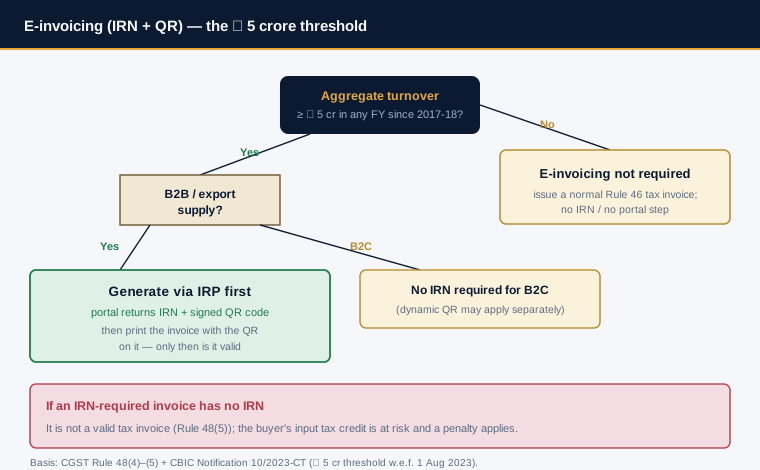
E-invoicing is mandatory for any business whose aggregate turnover crossed ₹5 crore in any financial year since 2017-18, under CBIC Notification 10/2023-Central Tax (effective 1 August 2023). It applies to B2B supplies, exports, supplies to SEZ, and reverse-charge supplies, not to B2C sales. You keep raising invoices in your own system; you must register each covered invoice with the Invoice Registration Portal first, which returns an Invoice Reference Number (IRN) and a signed QR code to print on the document. ₹5 crore remains the floor for FY 2026-27.
By Mrs. Swapna Patel
Published on 17 June 2026
Last modified on 17 June 2026
In this section
Answers
- Do I Have to Issue e-Invoices? The ₹5 Crore GST Threshold for FY 2026-27
- What Must You Verify Before Submitting Your ITR for AY 2026-27?
- What Is GSTR-1, the GST Return of Outward Supplies?
- What Is GSTR-3B, the Monthly GST Summary Return?
- What Is the Time of Supply Under GST, and When Does Tax Become Due?
- Advance Receipt Under GST: When Do You Issue a Receipt Voucher?
- Credit Note vs Debit Note Under GST: When Do You Issue Each?
- What Is GSTR-2B, and Why Does It Now Decide Your Input Tax Credit?
- What Is the Value of Supply Under Section 15 of the CGST Act?
- What Are the GST Rate Slabs in India After the GST 2.0 Reform?
E-invoicing means you stop making your own bills and start typing each invoice into the GST portal.
You still raise the invoice in your own billing software. E-invoicing only means each one is registered with a government portal (the IRP) first, which returns an IRN and a signed QR code to print on it.
Do I have to issue e-invoices?
Short answer
Yes, if your aggregate turnover crossed ₹5 crore in any financial year since 2017-18. CBIC Notification 10/2023-Central Tax[1] sets the threshold at ₹5 crore with effect from 1 August 2023, and ₹5 crore is still the floor for FY 2026-27.
- The threshold is tested on aggregate turnover, the PAN-level total of all your GST registrations, not on any single GSTIN or branch.
- Once you cross ₹5 crore in even one financial year from 2017-18 onward, e-invoicing stays mandatory, even if a later year falls back below ₹5 crore.
- Why it matters: an invoice that should carry an Invoice Reference Number (IRN) but does not is not a valid tax invoice under Rule 48(5) of the CGST Rules[2]. Your buyer then loses input tax credit, the GST they paid you that they were entitled to set off, and you face a penalty for an incorrect invoice.
- The ₹5 crore figure is year-variable: the GST Council has discussed cutting it to ₹2 crore, but as of FY 2026-27 no lower threshold has been notified. Check the CBIC notifications page[5] before assuming you are below the line.
What counts towards the ₹5 crore aggregate turnover?
Short answer
Aggregate turnover is the all-India, PAN-level total of taxable supplies, exempt supplies, exports, and inter-state supplies, computed for any financial year since 2017-18.
- It is computed across every GSTIN registered under the same PAN, so a business with units in three states adds all three together.
- It includes exempt and zero-rated supplies, not only the taxable ones, which pulls some businesses over the line sooner than they expect.
- It excludes the GST itself (CGST, SGST, IGST, and cess) and the value of inward supplies taxed under reverse charge, where you pay the tax instead of your supplier.
- The test reaches back: a year as far back as 2017-18 counts. The current FY turnover alone does not decide it.
Which of my supplies need an IRN, and which do not?
| Supply type | E-invoice (IRN) needed? | Why |
|---|---|---|
| B2B (sale to a GST-registered buyer) | Yes | The buyer claims input tax credit; the IRN locks the invoice into the system. |
| Export of goods or services | Yes | Treated like a B2B supply for e-invoicing. |
| Supply to an SEZ (Special Economic Zone) unit | Yes | A supply into an SEZ is covered, even though SEZ units as sellers are exempt. |
| Reverse-charge supply | Yes | Covered where the supplier is over the ₹5 crore threshold. |
| B2C (sale to an unregistered consumer) | No | No input tax credit at the buyer end, so no IRN is required. |
| Credit notes and debit notes on covered supplies | Yes | These follow the underlying B2B invoice. |
IRN means Invoice Reference Number, the unique number the government portal returns for each registered invoice. B2B = business to a registered business; B2C = business to consumer. Source: Rule 48(4), CGST Rules[2].
Who is exempt even above ₹5 crore?
Short answer
Some classes of registered person are exempt from e-invoicing regardless of turnover, under Notification 13/2020 and 61/2020[3]. If you fall in one of these, you issue an ordinary Rule 46 tax invoice with no IRN.
- Banks, insurers, financial institutions, and Non-Banking Financial Companies (NBFCs).
- Goods Transport Agencies (a GTA, a road-transport operator that issues a consignment note) for their transport services.
- Suppliers of passenger transport services.
- Admission to the screening of films in a multiplex cinema.
- SEZ units, as suppliers. Note the split: an SEZ unit selling out is exempt, but a supply made into an SEZ is covered.
What changes in my billing once I cross the threshold?
Short answer
You register each covered invoice with the Invoice Registration Portal (IRP) before issuing it; the IRP returns an IRN and a signed QR code that must be printed on the invoice given to the buyer.
One common mix-up: an e-invoice is not an e-way bill. The IRN proves the invoice was reported to the government; the e-way bill is a separate transport document for moving goods above a value threshold. Crossing into e-invoicing does not remove the e-way bill requirement. For the field-by-field anatomy of the tax invoice itself, see what fields a GST tax invoice must carry under Section 31 and Rule 46, and for the informal-slip trap, pakka bill vs kaccha bill.
- Step 1, raise the invoice as usual: you keep using your own billing software. E-invoicing does not mean typing invoices into the GST portal by hand.
- Step 2, send it to the IRP: your software uploads the invoice data to the Invoice Registration Portal (IRP), the government system that validates and registers each invoice.
- Step 3, receive the IRN and signed QR: the IRP returns an Invoice Reference Number (IRN), a unique 64-character code, and a digitally signed QR code. Both must be printed on the invoice you hand the buyer.
- Step 4, GSTR-1 fills itself: a registered e-invoice auto-populates your GSTR-1 (the monthly outward-supply return), so the B2B invoice details flow into the return without re-keying.
References
- 1.CBIC Notification 10/2023-Central Tax (₹5 crore e-invoicing threshold) — Lowered the e-invoicing turnover threshold to ₹5 crore with effect from 1 August 2023.
- 2.Rule 48(4) and 48(5), Central Goods and Services Tax Rules 2017 — CBIC — E-invoicing mandate; an IRN-required invoice without an IRN is not a valid tax invoice.
- 3.Notification 13/2020-Central Tax and 61/2020-Central Tax — CBIC — Classes of registered persons exempt from e-invoicing, including SEZ units.
- 4.GST e-Invoice System — National Informatics Centre — IRN generation, the Invoice Registration Portal, and IRN lookup for B2B supplies.
- 5.CBIC GST notifications portal — Official portal listing CBIC GST notifications; check here for any change to the e-invoicing turnover threshold.
References & related
Primary sources
- CBIC Notification 10/2023-Central Tax (₹5 crore e-invoicing threshold)Lowered the e-invoicing turnover threshold to ₹5 crore with effect from 1 August 2023.
- Rule 48(4) and 48(5), Central Goods and Services Tax Rules 2017 — CBICE-invoicing mandate; an IRN-required invoice without an IRN is not a valid tax invoice.
- Notification 13/2020-Central Tax and 61/2020-Central Tax — CBICClasses of registered persons exempt from e-invoicing, including SEZ units.
- GST e-Invoice System — National Informatics CentreIRN generation, the Invoice Registration Portal, and IRN lookup for B2B supplies.
- CBIC GST notifications portalOfficial portal listing CBIC GST notifications; check here for any change to the e-invoicing turnover threshold.