GST · 25 June 2026
CGST, SGST, IGST: What Are the Three GST Components and When Does Each Apply?
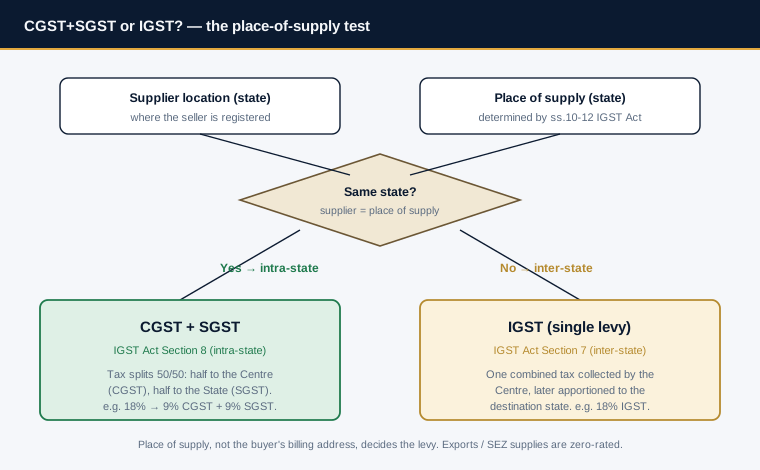
GST is collected through three components. CGST (Central GST) and SGST (State GST) are levied together on an intra-state supply, splitting the rate in half between the Centre and the state. IGST (Integrated GST) is a single levy on an inter-state supply, collected by the Centre and apportioned to the destination state. CGST is levied under Section 9 of the CGST Act, SGST under Section 9 of the respective State GST Act, and IGST under Section 5 of the IGST Act. Which component a given invoice carries is decided entirely by the place of supply: same state means CGST + SGST, different states means IGST. The rate is the same either way; only the heads differ.
By Mrs. Swapna Patel
Last reviewed
25 June 2026
In this section
Answers
- CGST, SGST, IGST: What Are the Three GST Components and When Does Each Apply?
- What Is a Pakka Bill? The GST Invoice That Counts as Valid
- What Is a Kaccha Bill? Why the Rough Slip Has No GST Standing
- Why Move From a Kaccha Bill to a Pakka Bill?
- How to Upgrade From a Kaccha Bill to a Pakka Bill (GST Invoice)
- 5 GST Invoice Mistakes That Trigger a Tax Notice (And How to Fix Them)
- 7 Fields Every Skilled Professional Must Put on a GST Invoice: Rule 46 Checklist
- What Makes a GST Invoice Legally Binding — And Why Clients Pay Faster When It Is
- What Is a Bill of Supply? The GST Document Without Tax
- What Is an IRN (Invoice Reference Number) Under GST?
GST is one tax, so it should not matter which component appears on the invoice.
GST is levied as three components. An intra-state sale carries CGST + SGST; an inter-state sale carries IGST. The split is fixed by Section 9 of the CGST Act and Section 5 of the IGST Act, and a wrong component blocks the buyer's credit.
What are the three components of GST?
Short answer
CGST (central), SGST (state), and IGST (integrated). Section 9 of the CGST Act and the matching State GST Act levy CGST + SGST on intra-state supplies; Section 5 of the IGST Act levies IGST on inter-state supplies.
- CGST, Central GST: the central government's share, levied under Section 9 of the CGST Act.
- SGST, State GST: the state government's share, levied under Section 9 of the respective State GST Act. UTGST replaces SGST in Union Territories without their own legislature.
- IGST, Integrated GST: a single combined levy on inter-state supplies under Section 5 of the IGST Act, collected by the Centre and apportioned to the destination state.
- The three never all appear on one supply: it is either CGST + SGST together, or IGST alone.
When does each GST component apply?
Short answer
The place of supply decides it. Same state as the supplier is an intra-state supply (CGST + SGST); a different state is an inter-state supply (IGST), under Sections 7 and 8 of the IGST Act.
| Component | Applies when | Goes to | Statute |
|---|---|---|---|
| CGST | Intra-state supply (same state) | Central government | Section 9, CGST Act |
| SGST | Intra-state supply (same state), alongside CGST | State government of the supply state | Section 9, State GST Act |
| IGST | Inter-state supply (different states) or import/export | Centre, then apportioned to the destination state | Section 5, IGST Act |
Source: Section 9, CGST Act and Section 5, IGST Act. The same-state versus different-state test that picks the component is set out in our place-of-supply guide.
How does an 18% rate split between CGST and SGST?
Short answer
Equally. On an intra-state supply an 18% GST becomes 9% CGST plus 9% SGST; on an inter-state supply it stays a single 18% IGST. The total tax is identical; only the heads differ.
- A ₹1,000 intra-state supply at 18% carries ₹90 CGST and ₹90 SGST, ₹180 in all.
- The same ₹1,000 supplied inter-state carries ₹180 IGST as one line, the same total.
- Why it matters: the buyer claims input tax credit under the exact head charged, so the CGST/SGST or IGST split on your invoice must match the place of supply, or their credit mismatches at reconciliation.
- Use the GST calculator to break any inclusive or exclusive amount into the correct component split.
Where does UTGST fit among the three?
Short answer
UTGST is the fourth head: it replaces SGST in a Union Territory that has no legislature, so the split there is CGST + UTGST instead of CGST + SGST, levied under the UTGST Act 2017.
The mechanics are identical to CGST + SGST; only the state component changes name and statute. For the full UTGST picture, see what UTGST is and where CGST + UTGST replaces CGST + SGST.
References & related
Primary sources
- Section 9, Central Goods and Services Tax Act 2017 (CGST levy) — India CodeLevy and collection of the central component of GST on an intra-state supply.
- Section 5, Integrated Goods and Services Tax Act 2017 (IGST levy) — India CodeLevy and collection of integrated tax on an inter-state supply.
- State GST Acts, Section 9 (SGST levy) — CBIC GST portalThe state component, levied under the corresponding section of each State GST Act, mirrors CGST on an intra-state supply.
- Sections 7–8, IGST Act 2017 (inter-state and intra-state supply) — India CodeDefine which supplies are inter-state (IGST) and intra-state (CGST + SGST).
Last reviewed: 25 June 2026