Tax Guide · 19 June 2026
Can an NRI Claim HRA, and What About Rent Paid to an NRI Landlord?
A Non-Resident Indian can claim the HRA exemption under Section 10(13A) of the Income Tax Act on salary that is taxable in India, using the same least-of-three formula and the same rent receipts a resident uses, provided they file under the Old Tax Regime. Where an NRI has no HRA in their Indian salary, Section 80GG offers up to Rs. 60,000 a year instead. The separate, more common trap is on the tenant side: anyone paying rent to an NRI landlord must deduct TDS under Section 195 at roughly 31.2% from the first rupee, obtain a TAN, file Form 27Q, and lodge Form 15CA (with Form 15CB above Rs. 5 lakh). None of that applies to the 2% Section 194-IB rate on a resident landlord.
By Mrs. Kritika Joshi
Published on 19 June 2026
Last modified on 19 June 2026
By Mrs. Kritika Joshi
Published 19 June 2026
Updated 19 June 2026
In this section
Answers
- Can an NRI Claim HRA, and What About Rent Paid to an NRI Landlord?
- What does a ₹1 revenue stamp on a rent receipt actually prove?
- What turnover thresholds make GST registration mandatory in 2026?
- GSTR-1, GSTR-2B and GSTR-3B: Which GST Return Is Which, and How?
- What Is the Time of Supply Under GST, and When Does Tax Become Due?
- What Is the Value of Supply Under Section 15 of the CGST Act?
- What Are the GST Rate Slabs in India After the GST 2.0 Reform?
- Exempt vs Nil-Rated vs Zero-Rated Supply: What Is the Difference?
- Composite vs Mixed Supply Under Section 8: Which GST Rate Applies?
- What Is TCS Under GST? The Tax E-Commerce Platforms Collect
NRIs cannot claim HRA, and rent paid to an NRI landlord is treated the same as rent to any other landlord.
An NRI with salary taxable in India can claim HRA under Section 10(13A)[1]; and a tenant paying an NRI landlord must deduct TDS at about 31.2% from the first rupee under Section 195, not the 2% resident rate.
Can an NRI claim HRA exemption in India?
Short answer
Yes, if the salary the HRA sits in is taxable in India. Section 10(13A)[1] does not bar non-residents; it asks whether you draw HRA in an India-taxable salary and pay rent for a home in India.
The common case is a seconded employee or someone on Indian payroll while posted abroad whose salary is still charged to tax in India. The residential status decides which income India taxes, not whether the HRA rule applies to the salary it does tax.
Two conditions still bite. You must file under the Old Tax Regime, because the New Regime switches off the HRA exemption entirely. And the rented home must be in India, with rent receipts to match.
How is the NRI HRA exemption calculated?
Short answer
Exactly as it is for a resident: the exemption is the lowest of three figures under Section 10(13A)[1] read with Rule 2A (renumbered Rule 279 from FY 2026-27). There is no separate NRI formula.
Compute all three and take the smallest. For FY 2026-27, the 50% metro list runs to eight cities under Rule 279 of the Income-tax Rules 2026, in force from 1 April 2026: Delhi, Mumbai, Kolkata, Chennai, Bengaluru, Hyderabad, Pune, and Ahmedabad; every other city takes 40%. A belated or revised FY 2025-26 return still uses the old four-city list (Delhi, Mumbai, Kolkata, Chennai).
| Cap | Formula |
|---|---|
| (a) Actual HRA | The HRA actually received in the India-taxable salary |
| (b) Salary percentage | 50% of basic salary for a home in one of the 8 metros (Delhi, Mumbai, Kolkata, Chennai, Bengaluru, Hyderabad, Pune, Ahmedabad under Rule 279 from FY 2026-27), 40% elsewhere |
| (c) Excess rent | Rent paid minus 10% of basic salary |
Source: Section 10(13A) read with Rule 2A, renumbered Rule 279 from FY 2026-27[1]. The full worked method is in our HRA exemption calculation guide.
What if the NRI salary has no HRA?
Short answer
Then Section 80GG takes over, capped at Rs. 5,000 a month (Rs. 60,000 a year), claimed by filing Form 10BA before the ITR.
Section 80GG covers a salaried NRI whose Indian pay carries no HRA, and a self-employed NRI with India-source business income. The same not-own-a-home-in-that-city condition applies, and it too needs the Old Tax Regime. Why it matters: most NRIs assume zero HRA means zero relief on rent, and leave the Rs. 60,000 deduction on the table.
What rent receipts does an NRI need?
Short answer
The same India-compliant monthly receipts a resident keeps: month, landlord name and address, amount in figures and words, and the landlord PAN once annual rent crosses Rs. 1,00,000.
You do not file receipts with the ITR; you keep them for six years against scrutiny. The 14-field format is set out in our Section 10(13A) rent receipt checklist. For digital rent, record the UTR so the receipt can be matched to the bank trail. Generate compliant monthly rent receipts.
Paying rent to an NRI landlord: what changes?
Short answer
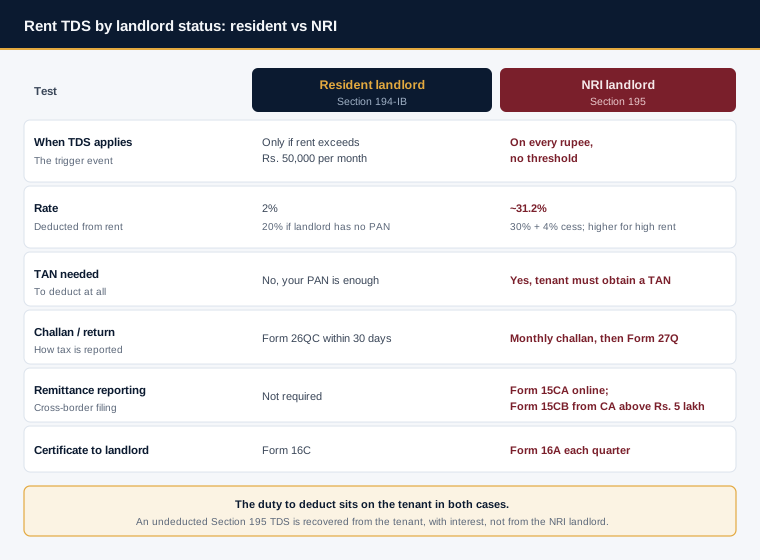
Everything. Under Section 195[2] you must deduct TDS from the first rupee at about 31.2% (30% plus 4% cess), get a TAN, and report the remittance, none of which the resident-landlord rule asks for.
This is the part most tenants miss. If your landlord is an NRI, the gentle Section 194-IB regime does not apply; Section 195 does, and it is far heavier.
| Test | Resident landlord (Section 194-IB) | NRI landlord (Section 195) |
|---|---|---|
| When TDS applies | Only if rent exceeds Rs. 50,000 per month | On every rupee, no threshold |
| Rate | 2% (20% if landlord has no PAN) | About 31.2% (30% + 4% cess); higher for very high rent |
| TAN needed | No, your PAN is enough | Yes, the tenant must obtain a TAN |
| Challan / return | Form 26QC within 30 days | Monthly challan, then quarterly Form 27Q |
| Remittance reporting | Not required | Form 15CA online; Form 15CB from a CA above Rs. 5 lakh |
| Certificate to landlord | Form 16C | Form 16A after each quarter |
Sources: Section 194-IB[3] and Section 195, Income Tax Act 1961[2]. The NRI landlord can apply under Section 197 for a lower or nil deduction certificate; without one, the full rate stands.
Who is responsible if the NRI TDS is missed?
Short answer
The tenant. The duty to deduct sits on the payer, so an undeducted Section 195 TDS is recovered from you, with interest and a possible disallowance, not from the NRI landlord.
- The payer is the deductor: a tenant who pays an NRI landlord without deducting is treated as an assessee-in-default for the tax that should have been withheld.
- Interest runs from the date deduction was due, and a separate penalty can apply for the failure to deduct or to file Form 27Q.
- Fix it at the start of the tenancy: confirm the landlord's residential status before the first payment, get a TAN, and deduct from month one rather than discovering the gap at year-end.
- Keep the trail: a UTR-stamped payment receipt plus the TDS challan is what an officer expects, the same evidence logic as a verified rent receipt for HRA.
References
- 1.Section 10(13A) and Rule 2A, Income Tax Act 1961 — Income Tax Department — HRA exemption and the least-of-three computation; available to any salaried person, including an NRI, whose salary is taxable in India.
- 2.Section 195, Income Tax Act 1961 — Income Tax Department — TDS on any sum (including rent) paid to a non-resident; deduction from the first rupee, no threshold.
- 3.Section 194-IB, Income Tax Act 1961 — Income Tax Department — Resident-landlord rent TDS: 2% above Rs. 50,000 per month, Form 26QC, no TAN required. The contrast that makes the NRI case different.
- 4.Section 80GG and Form 10BA — Income Tax Department — Rent deduction up to Rs. 60,000 a year where no HRA is received.
- 5.Form 15CA / 15CB and Form 27Q — Income Tax e-Filing portal — Remittance reporting and the quarterly TDS return for payments to a non-resident.
References & related
Primary sources
- Section 10(13A) and Rule 2A, Income Tax Act 1961 — Income Tax DepartmentHRA exemption and the least-of-three computation; available to any salaried person, including an NRI, whose salary is taxable in India.
- Section 195, Income Tax Act 1961 — Income Tax DepartmentTDS on any sum (including rent) paid to a non-resident; deduction from the first rupee, no threshold.
- Section 194-IB, Income Tax Act 1961 — Income Tax DepartmentResident-landlord rent TDS: 2% above Rs. 50,000 per month, Form 26QC, no TAN required. The contrast that makes the NRI case different.
- Section 80GG and Form 10BA — Income Tax DepartmentRent deduction up to Rs. 60,000 a year where no HRA is received.
- Form 15CA / 15CB and Form 27Q — Income Tax e-Filing portalRemittance reporting and the quarterly TDS return for payments to a non-resident.