GST · 25 June 2026
Place of Supply in GST: Does Your Invoice Charge CGST+SGST or IGST?
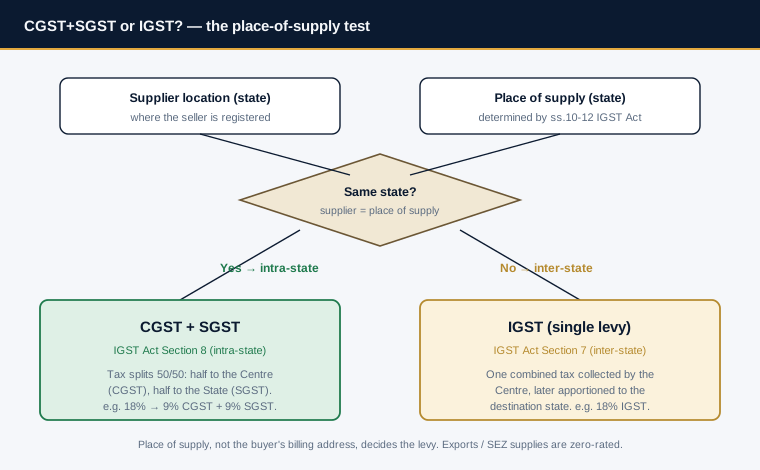
Place of supply is the rule that decides where a supply is deemed to occur, and therefore which GST applies. Compare the supplier's state with the place of supply: same state is an intra-state supply, charged as CGST + SGST under Section 8 of the IGST Act; different states is an inter-state supply, charged as a single IGST under Section 7. Sections 10 to 12 of the IGST Act fix the place of supply itself, separately for goods and services, and for bill-to/ship-to deliveries the place of supply is the principal place of business of the party billed, not the delivery address. The common error is using the buyer's billing address instead of the statutory place of supply, which produces the wrong tax split and fails return reconciliation.
By Mrs. Swapna Patel
Last reviewed
25 June 2026
In this section
Answers
- Place of Supply in GST: Does Your Invoice Charge CGST+SGST or IGST?
- What Is a Pakka Bill? The GST Invoice That Counts as Valid
- What Is a Kaccha Bill? Why the Rough Slip Has No GST Standing
- Why Move From a Kaccha Bill to a Pakka Bill?
- How to Upgrade From a Kaccha Bill to a Pakka Bill (GST Invoice)
- 5 GST Invoice Mistakes That Trigger a Tax Notice (And How to Fix Them)
- 7 Fields Every Skilled Professional Must Put on a GST Invoice: Rule 46 Checklist
- What Makes a GST Invoice Legally Binding — And Why Clients Pay Faster When It Is
- What Is a Bill of Supply? The GST Document Without Tax
- What Is an IRN (Invoice Reference Number) Under GST?
A customer in another state always means you charge IGST, and the billing address on their letterhead decides it.
It is the statutory place of supply under Sections 10–12 of the IGST Act, not the billing address, that decides CGST+SGST versus IGST.
What does place of supply decide on a GST invoice?
Short answer
It decides which GST you charge. Compare your state with the place of supply: same state is intra-state (CGST + SGST under Section 8 of the IGST Act); different states is inter-state (a single IGST under Section 7).
Every GST invoice has to answer one structural question before the tax line can be filled in: is this supply intra-state or inter-state? The place of supply, fixed by law, supplies the answer. Get it wrong and the whole tax split on the invoice is wrong.
- The two inputs are your location (the state where you are registered) and the place of supply (fixed by Sections 10 to 12 of the IGST Act).
- Same state: charge CGST + SGST. An 18% rate becomes 9% CGST plus 9% SGST, the central half to the Centre and the state half to the supply state.
- Different states: charge a single IGST at the full 18%, collected by the Centre and apportioned to the destination state.
- Why it matters: a wrong split is one of the cleanest ways to fail GSTR return reconciliation, because the buyer claims credit under the wrong head.
How do you tell an intra-state supply from an inter-state supply?
Short answer
One comparison: supplier state versus place of supply. Same state is intra-state (Section 8); different states, or one outside India, is inter-state (Section 7).
| Test result | Supply type | Tax charged | Statute |
|---|---|---|---|
| Supplier state = place of supply | Intra-state | CGST + SGST | Section 8, IGST Act |
| Supplier state ≠ place of supply | Inter-state | IGST (single line) | Section 7, IGST Act |
| Place of supply outside India / export | Inter-state, zero-rated | IGST at nil effective rate | Section 7 read with Section 16 |
Source: Sections 7 and 8, IGST Act 2017. Exports and supplies to SEZ units are inter-state but zero-rated, so they sit in the IGST branch at a nil effective rate. See the place-of-supply decision exhibit.
What is the bill-to/ship-to rule when delivery goes elsewhere?
Short answer
For a bill-to/ship-to sale of goods, Section 10(1)(b) of the IGST Act deems the place of supply to be the principal place of business of the party billed (the bill-to), not the address where the goods are delivered (the ship-to).
- When A bills you but asks you to ship to A's customer B in another state, the place of supply for your invoice is A's registered location, because A directed the supply.
- A then raises a second invoice to B, whose place of supply is B's location. Two invoices, two place-of-supply tests.
- Why it matters: using the ship-to delivery address as the place of supply is the most common bill-to/ship-to error, and it puts the wrong tax head on the invoice.
- The principle holds across goods: it is the statutory place of supply under Section 10, not the address on the buyer's letterhead, that governs the split.
Why does getting place of supply wrong cost you?
Short answer
A wrong place of supply produces the wrong tax head (CGST+SGST instead of IGST or vice versa), which fails return reconciliation and can block the buyer's input tax credit.
- The buyer's input tax credit is claimed under a specific head; if you charged IGST where CGST+SGST was due, the credit they claim does not match what you reported.
- Correcting a wrong split after issue means a credit note and a fresh invoice, with the reconciliation mismatch visible in the GST system in the meantime.
- Place of supply is also a mandatory Rule 46 field on the invoice itself; see what fields a GST tax invoice must carry under Section 31 and Rule 46.
- A pakka bill generator applies the same-state versus different-state test and fills the correct CGST/SGST or IGST line, so the split matches the place of supply from the first download.
References & related
Primary sources
- Section 7, Integrated Goods and Services Tax Act 2017 (inter-state supply) — India CodeA supply where supplier location and place of supply are in different states is inter-state, charged to IGST.
- Section 8, Integrated Goods and Services Tax Act 2017 (intra-state supply) — India CodeA supply where supplier location and place of supply are in the same state is intra-state, charged to CGST + SGST.
- Sections 10–12, Integrated Goods and Services Tax Act 2017 (place of supply) — India CodeSection 10 fixes place of supply for goods, including the bill-to/ship-to rule; Sections 11–12 cover imports and services.
- GST portal — CBICOfficial GST reference for tax type and place-of-supply guidance.
Last reviewed: 25 June 2026