Typed vs Handwritten Rent Receipts: Which Actually Clears Rule 26C in 2026?
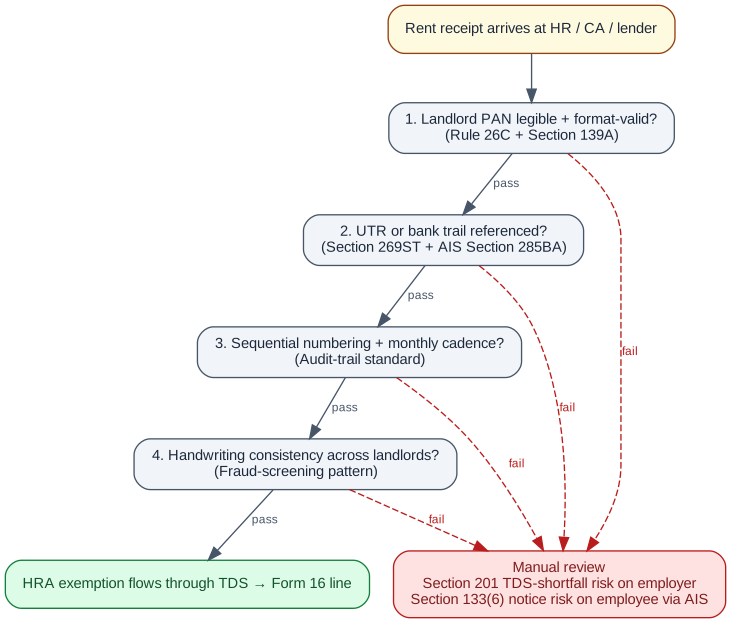
Handwritten rent receipts are not illegal under Indian tax law, but four audit checks HR teams now run under Rule 26C disqualify most of them in practice: PAN legibility, UTR anchor, sequential numbering, and handwriting consistency. This guide walks through each failure mode, the two myths that keep handwritten receipts in circulation, and what verifiers accept in 2026.
Are handwritten rent receipts legal under Indian tax law?
Short answer
Yes. But four audit checks under Rule 26C of the Income Tax Rules 1962 now disqualify most of them in practice: PAN legibility, UTR anchor, sequential numbering, and handwriting consistency.
A handwritten receipt with a revenue stamp used to be the default proof of rent paid in India. It still circulates, printed pads from the stationery shop, filled in by the landlord, signed in blue ink. HR teams, chartered accountants, and lender underwriters now treat that artefact as the start of an audit, not the end of one.
The shift is statutory, not stylistic. Rule 26C obliges the employer to collect landlord name, address, PAN or Aadhaar, and amount when total annual rent exceeds Rs 1,00,000. Section 192(2D) of the Income Tax Act 1961 makes the employer responsible for verifying that proof before granting HRA exemption at the TDS stage. The employee submits Form 12BB, renamed Form 124 from 1 April 2026 under the new Income Tax Rules 2026, declaring the figures; the employer carries the liability for accepting them. That liability is what drives the four checks below.
Why do handwritten landlord PANs fail HR validation?
Short answer
A PAN is five letters, four digits, one letter, and handwritten characters confuse the format. Roughly one in seven handwritten PANs bounce on automated format validation before anyone asks the deeper question of ownership.
- Handwritten "8" reads as "B". "0" reads as "O". "1" reads as "I" or "l". HR teams running PAN-format validators on Form 12BB submissions see around 14 percent of handwritten PANs bounce on format alone.
- Format-valid is the lower bar. The higher bar is whether the PAN belongs to the named landlord. Payroll vendors integrate the Income Tax Department PAN Verification API for typed receipts where the PAN is captured as a structured field. Handwriting blocks that integration.
- Handwritten receipts must be transcribed before validation. Transcription is where audit risk enters; HR teams re-keying 200 PANs in a quarter introduce error in the cross-check layer rather than at the receipt.
- After the PAN 2.0 rollout on 1 July 2025, any Indian adult can obtain an instant e-PAN via Aadhaar OTP in roughly ten minutes at zero cost. "My landlord refused PAN" is no longer a defensible position above the Rs 1 lakh threshold.
- For landlords below the threshold or with no PAN obtained, see the HRA without landlord PAN path.
Why does a handwritten receipt without UTR fail the AIS reconciliation check?
Short answer
Bank-channel rent payments now appear in the Annual Information Statement under Section 285BA. A receipt without a UTR field cannot be matched against the AIS line, which is the cross-check verifiers run first.
A real rent payment leaves a Unique Transaction Reference on the payer's bank statement. The receipt should reference it. Handwritten pad receipts almost never do.
- Section 269ST of the Income Tax Act 1961 caps cash receipts at Rs 2,00,000 in aggregate per person per occasion or per transaction. Rent paid in cash above that threshold is disallowed at the recipient end and triggers a penalty equal to the amount received.
- The Annual Information Statement, mandated under Section 285BA, captures rent paid through banking channels above Rs 50,000 per month from FY 2025-26 onward. Tenant-side outflow flows to the landlord-side AIS line.
- A handwritten receipt claiming Rs 40,000 per month while AIS shows Rs 55,000 per month, or the reverse, produces a Section 133(6) scrutiny flag.
- Typed receipts can carry a structured UTR field that maps to the bank entry. Handwritten receipts skip the UTR field, which blocks machine reconciliation.
- Verifiers reading a handwritten receipt with no UTR field are entitled to ask: was this paid in cash, and if so, how does the bundle stay under 269ST? See the full Section 269ST cash transaction limit treatment.
How does HR detect a back-dated handwritten receipt bundle?
Short answer
Real twelve-month tenancies produce twelve receipts in sequence with monotonic dates and consistent amounts. Bundles manufactured in one sitting fail on ink consistency, date clusters within a single week, and missing receipt numbers.
- Receipt count must match the tenancy months declared on Form 12BB. A twelve-month claim with eleven or thirteen receipts raises a question that takes ninety minutes to resolve against handwritten slips, thirty seconds against typed ones.
- Monthly amount consistency must track documented rent revisions. Jumps that do not correspond to a registered rent agreement amendment surface in the AIS reconciliation.
- Date stamps on a manufactured bundle cluster within a single signing session. Real twelve-month bundles spread across the tenancy year; handwritten back-dating compresses them into one ink run.
- Sequential numbering on a real bundle increments one per month. Stationery-shop pads carry their own sequential numbers, and slip 12 should be eleven higher than slip 1.
- Receipts for months the employee was on foreign deputation or visa, while claiming to pay Indian rent, raise an immediate flag against passport stamps or travel logs.
- The 14-field Section 10(13A) rent receipt checklist lists the structured fields a real receipt should carry. Eleven of the fourteen are structured fields a typed format enforces and a handwritten pad does not.
Can fraud-screening software catch AI-generated handwritten receipts?
Short answer
Yes. Pattern-matching detects same-handwriting style across multiple alleged landlords, AI-handwriting model outputs, and synthetic ink consistency. Verifier trust has shifted from visual authenticity to cryptographic anchoring of the document itself.
- The fraud pattern is mechanical. Employee submits twelve new receipts from a new landlord; handwriting matches the prior year receipts from a different landlord. HR teams running 200 Form 12BBs in a quarter do not catch this by eyeball. Pattern-matching software does.
- Open-source handwriting models and document-synthesis tools turn a convincing handwritten bundle into a forty-minute exercise in 2026. AI-handwriting outputs show synthetic consistency across letters that machine-vision detectors flag at around 92 percent accuracy on public benchmarks.
- Verifiers have responded by shifting trust anchors away from visual authenticity and toward cryptographic anchoring of the document. A signed-QR receipt resists every category of fabrication that handwriting cannot.
- The seven signs of AI-generated salary slips frame applies almost verbatim to rent receipts. Font inconsistency, alignment failure, signatory mismatch, watermark layering all carry the same signal.
What myths keep handwritten rent receipts in circulation?
Short answer
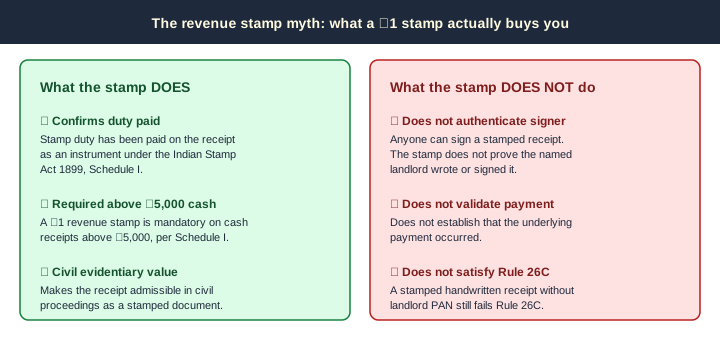
Two: that a revenue stamp authenticates the receipt, and that digital or typed receipts are not legally valid in India. Primary-source statute contradicts both.
The myths circulate because the stationery-shop ecosystem rewards them. Pre-printed pads with revenue-stamp grids sell at every legal supplies counter; typing a receipt at home and printing it carries a fraction of the friction. Friction keeps handwritten receipts alive after they have lost their legal advantage.
- **Myth 1: A revenue stamp makes a receipt legally valid.** The Indian Stamp Act 1899, Schedule I requires a one-rupee revenue stamp on receipts for cash payments above Rs 5,000. The stamp confirms that duty has been paid on the receipt as an instrument. It does not authenticate the signer, bind the landlord to the transaction, or establish that the underlying payment occurred.
- A bundle of stamped handwritten receipts and a bundle of unstamped electronic receipts carry identical evidentiary weight on the question Rule 26C asks: was rent paid, to whom, with what PAN.
- **Myth 2: Digital or typed receipts are not legally valid.** Section 4 of the Information Technology Act 2000 establishes that electronic records have the same legal validity as paper records. Section 5 recognises digital signatures as equivalent to wet signatures. Both have been operative since October 2000.
- The Income Tax e-filing portal accepts digital receipts as evidence. CBDT circulars after 2017 permit electronic Form 12BB submission. A typed PDF receipt with a structured PAN field and a UTR reference is a stronger artefact than a handwritten one, because it survives all four Rule 26C checks without manual reconciliation.
What changed for FY 2026-27 in rent-receipt compliance?
Short answer
Three structural shifts: PAN 2.0 makes "my landlord has no PAN" untenable above Rs 1 lakh, AIS now ingests bank-channel rent above Rs 50,000 per month, and Faceless Assessment routes handwritten receipts to manual review at materially higher rates than typed ones.
- **Form 12BB renamed to Form 124** effective 1 April 2026 under the new Income Tax Rules 2026. Substance preserved, format updated. The Rs 1 lakh PAN trigger, Aadhaar substitute clause, and landlord name-and-address requirement carry over verbatim.
- **PAN 2.0** has been live since 1 July 2025. Instant e-PAN issuance through the income tax e-filing portal via Aadhaar OTP. PAN-Aadhaar linking became mandatory by 31 December 2025; unlinked PANs are now inoperative.
- **AIS rent line expansion** from FY 2025-26 captures bank-channel rent payments above Rs 50,000 per month via NEFT, IMPS, UPI, and RTGS. Tenant-side reporting feeds the landlord-side AIS line, producing the mismatch engine the CBDT uses to issue notices.
- **Faceless Assessment** under Section 144B handles HRA disallowance notices end-to-end. The system routes low-structure inputs (handwritten receipts, missing PAN blocks, AIS mismatches) to manual review at materially higher rates than typed receipts with structured fields.
What does an audit-ready rent receipt look like in 2026?
Short answer
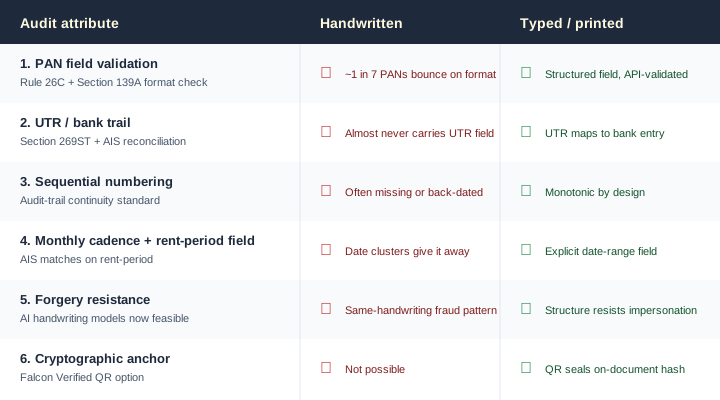
Six structured fields the handwritten pad cannot enforce: landlord PAN block, UTR reference, sequential receipt number, explicit rent-period date range, tenant-landlord PAN cross-reference, and an issuer signature anchored to document content.
- **Landlord PAN block** as a structured field with format validation. Aadhaar accepted as the permitted substitute under the Form 12BB footnote.
- **UTR or transaction reference** on each monthly receipt. Cash receipts without a banking reference are the first artefacts AIS reconciliation rejects.
- **Sequential numbering** monotonic across the financial year. An employer running a year-end audit sees continuous occupation without gaps.
- **Explicit rent-period field** as a date range from the start of the month to the end of the month, not just "April rent". AIS reconciliation matches on rent-period, not on receipt date.
- **Landlord name and address** spelled identically across every monthly receipt. AIS reconciliation is character-sensitive; small differences break the match.
- **Cryptographic anchor** through Falcon Verified QR, optional but increasingly standard. The QR seals the document content at issuance; any later edit invalidates the seal.
Primary sources
- Rule 26C, Income Tax Rules 1962 — Employer evidence requirement when annual rent exceeds Rs 1 lakh.
- Section 192(2D), Income Tax Act 1961 — Statutory hook for employer TDS verification of deduction claims.
- Form 12BB (Rule 26C statement) PDF — Form fields include PAN or Aadhaar of landlord above Rs 1 lakh.
- Form 124 (Form 12BB successor, effective 2026-04-01) — New Income Tax Rules 2026 form rename.
- Section 269ST, Income Tax Act 1961 — Rs 2 lakh aggregate cash receipt cap; 100 percent penalty.
- Section 285BA, Income Tax Act 1961 — AIS reporting basis. Rent line expansion from FY 2025-26.
- Section 139A, Income Tax Act 1961 — PAN format and allotment authority.
- Indian Stamp Act 1899, Schedule I — Revenue stamp requirement on cash receipts above Rs 5,000.
- Information Technology Act 2000, Section 4 — Electronic records carry equal legal validity to paper.
- Information Technology Act 2000, Section 5 — Digital signatures equivalent to wet signatures.
- PAN 2.0 / e-PAN portal — Instant Aadhaar-linked e-PAN issuance, live since 1 July 2025.
Tools and generators
No signup. No email. Your data never leaves your browser.