How Rent Receipts Fail Rule 26C: HRA Rs 1 Lakh PAN Threshold Across 24 Indian Cities (2026)
Across 24 Indian cities surveyed in May 2026, median 1BHK rent crosses the Rule 26C Rs 1 lakh threshold in 21 cities. Median 2BHK rent crosses it in all 24. Rule 26C compliance is the structural state of the urban rental market in 2026, not the exception.
What does Rule 26C require from a rent receipt above Rs 1 lakh?
Short answer
Rule 26C of the Income Tax Rules 1962 requires the employee to furnish landlord name, address, and PAN (or Aadhaar) to the employer on Form 12BB when aggregate annual rent exceeds Rs 1,00,000.
Rule 26C reads, verbatim: "The assessee shall furnish to the person responsible for making payment under sub-section (1) of section 192, the evidence or the particulars of the claims referred to in sub-rule (2), in Form No. 12BB for the purpose of estimating his income or computing the tax deduction at source."
Sub-rule (2) is the operative table. For House Rent Allowance, the prescribed evidence is: "Name, address and Permanent Account Number of the landlord/landlords where the aggregate rent paid during the previous year exceeds rupees one lakh." The statutory hook sits in Section 192(2D) of the Income Tax Act 1961, which empowers the CBDT to prescribe the manner in which an employee proves deduction claims to the employer for TDS computation.
- **Threshold:** aggregate rent paid during the previous year above Rs 1,00,000. Monthly rent of Rs 8,334 or higher across twelve months crosses it.
- **Required fields:** landlord name, landlord address, landlord PAN or Aadhaar. The Aadhaar substitute is a Form 12BB footnote: "Permanent Account Number or Aadhaar Number shall be furnished if the aggregate rent paid during the previous year exceeds one lakh rupees."
- **Submission instrument:** Form 12BB (or Form 124 from 1 April 2026 under the new Income Tax Rules 2026).
- **Employer duty:** verify the proof before granting HRA exemption at TDS source under Section 192(2D). Failure to verify carries a Section 201 disallowance risk on the employer.
- **Employee remedy if no employer verification:** claim HRA exemption directly in ITR-1 or ITR-2 with receipts attached, subject to faceless assessment scrutiny.
At what monthly rent does Rule 26C trigger?
Short answer
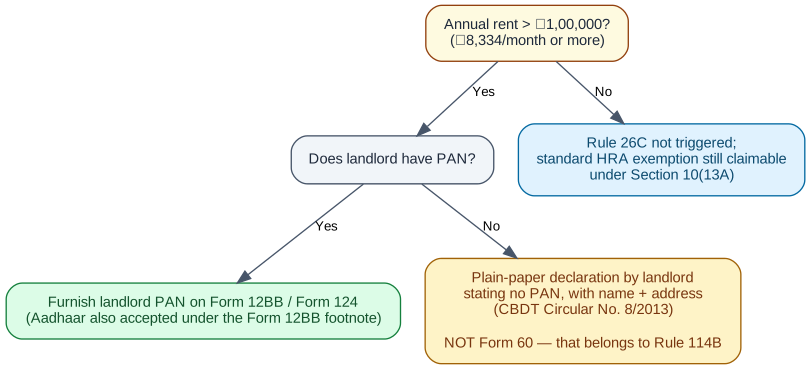
Rs 8,334 per month. Any monthly rent at or above this number, sustained across a twelve-month previous year, crosses the Rs 1,00,000 annual threshold and triggers the landlord-PAN furnishing obligation.
Rs 1,00,000 divided by 12 equals Rs 8,333.33 per month. Round up: Rs 8,334. That is the bright line.
Until 2015 this was a high bar in tier-2 India. A 1BHK in Jaipur, Lucknow, or Indore sat below Rs 8,000 a month, and the PAN block on the receipt was a tier-1 concern. In 2026 the math has inverted. Rs 8,334 a month is now the urban floor. A decade of rental inflation across the Magicbricks Rental PropIndex Q1 2026 panel and the Anarock 2BHK consumer survey, which records 64 percent rent growth over five years, has overrun a threshold the CBDT set in absolute rupees through Circular No. 8/2013 and never indexed.
How many of 24 surveyed Indian cities cross the Rule 26C threshold in 2026?
Short answer
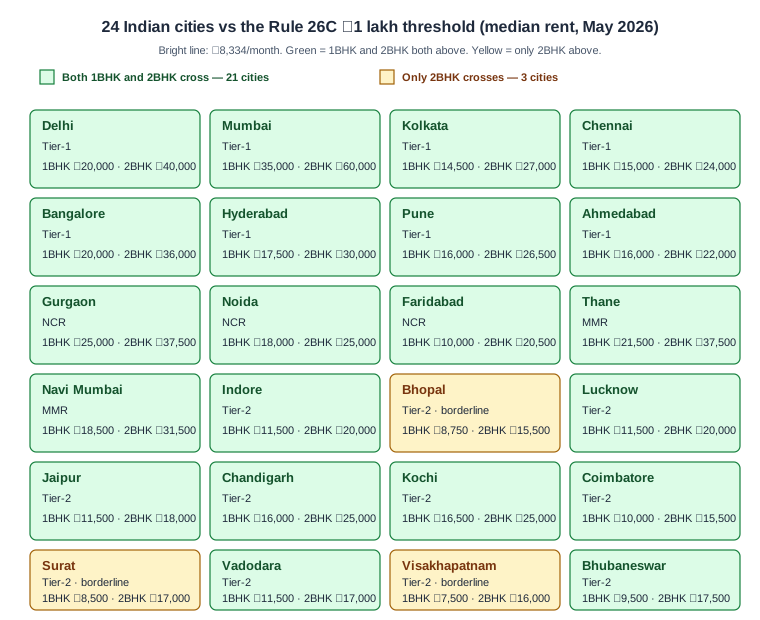
Twenty-one of twenty-four cities cross the threshold on a median 1BHK. All twenty-four cross it on a median 2BHK. Crossing is the structural state of the urban rental market in 2026, not the exception.
Median 1BHK and 2BHK rents were pulled in May 2026 from the Magicbricks Rental PropIndex Q1 2026, the Magicbricks Rental Index Q3 2025 where Q1 2026 data was unavailable, the Anarock 2BHK consumer survey 2024 on a standardised 1,000 sqft semi-furnished 2BHK, Knight Frank Institutionalising-Rental 2019, and 99acres / NoBroker / Square Yards locality aggregations for tier-2 cities not in Magicbricks rental panels. Tier-2 numbers carry a portal-aggregate caveat: they are listing asks, not transacted medians, and tend to overstate by 5-10 percent.
- Even non-metro Tier-2 1BHKs in Indore, Lucknow, Jaipur, and Vadodara now sit above the threshold. The PAN block on a rent receipt is no longer a metro-only concern.
- Only three cities (Bhopal, Surat, Visakhapatnam) have 1BHK medians at or below the threshold, and the 2BHK median in all three still crosses it. A working couple on a single 2BHK in these cities still triggers Rule 26C.
- The 2BHK universe is entirely above the threshold across all 24 cities. Family-sized urban rentals in India cannot be claimed for HRA without landlord-PAN furnishing.
| City | Tier | 1BHK Rs/mo | 2BHK Rs/mo | Crosses Rs 8,334/mo? |
|---|---|---|---|---|
| Delhi | Tier-1 | 20,000 | 40,000 | Both |
| Mumbai | Tier-1 | 35,000 | 60,000 | Both |
| Kolkata | Tier-1 | 14,500 | 27,000 | Both |
| Chennai | Tier-1 | 15,000 | 24,000 | Both |
| Bangalore | Tier-1 | 20,000 | 36,000 | Both |
| Hyderabad | Tier-1 | 17,500 | 30,000 | Both |
| Pune | Tier-1 | 16,000 | 26,500 | Both |
| Ahmedabad | Tier-1 | 16,000 | 22,000 | Both |
| Gurgaon | NCR | 25,000 | 37,500 | Both |
| Noida | NCR | 18,000 | 25,000 | Both |
| Faridabad | NCR | 10,000 | 20,500 | Both |
| Thane | MMR | 21,500 | 37,500 | Both |
| Navi Mumbai | MMR | 18,500 | 31,500 | Both |
| Indore | Tier-2 | 11,500 | 20,000 | Both |
| Bhopal | Tier-2 | 8,750 | 15,500 | Both |
| Lucknow | Tier-2 | 11,500 | 20,000 | Both |
| Jaipur | Tier-2 | 11,500 | 18,000 | Both |
| Chandigarh | Tier-2 | 16,000 | 25,000 | Both |
| Kochi | Tier-2 | 16,500 | 25,000 | Both |
| Coimbatore | Tier-2 | 10,000 | 15,500 | Both |
| Surat | Tier-2 | 8,500 | 17,000 | 2BHK only |
| Vadodara | Tier-2 | 11,500 | 17,000 | Both |
| Visakhapatnam | Tier-2 | 7,500 | 16,000 | 2BHK only |
| Bhubaneswar | Tier-2 | 9,500 | 17,500 | Both |
How many rent receipts actually carry landlord PAN today?
Short answer
No CBDT-published count exists in the public domain. The public record covers two facts: CBDT ran data-analysis on FY 2020-21 rent mismatches and issued mass notices via AIS reconciliation. That pattern recurs each tax year.
Stating a non-compliance percentage would be invention. The public record covers the methodology; the absolute counts remain unpublished.
- CBDT ran a data-analysis of high-value HRA mismatches in 2024 and issued mass notices on FY 2020-21 rent-paid-versus-rent-received mismatches surfaced through AIS reconciliation.
- The mismatch engine: the tenant's reported rent appears in AIS via salary TDS feeds and Form 12BB-derived disclosures. The landlord's reported rental income appears via Form 26AS, ITR filings, and bank-channel rent above Rs 50,000 per month. Differences trigger Section 133(6) notices.
- Rule 26C is the front-end gate that feeds this back-end check. A receipt without landlord PAN does not flow PAN into AIS, which means the landlord-side income line cannot be located, which is the gap CBDT mines.
- Enforcement tone hardened through 2025. Business Today coverage in March 2025 walks through the cross-reference logic in plain language and confirms mass HRA notices are a recurring annual cycle.
- Inference: across 24 urban markets where crossing the threshold is the structural state, even a 30-40 percent PAN-collection gap on Form 12BB / Form 124 means millions of non-compliant submissions per year, each carrying a downstream notice risk for the employee and a TDS-shortfall risk for the employer.
Does Form 60 work if the landlord has no PAN?
Short answer
No. Form 60 belongs to Rule 114B, which covers specified high-value transactions (motor vehicle, bank account, fixed deposits). It has no statutory role in Rule 26C compliance.
Several tax blogs and some HR teams incorrectly instruct employees to file Form 60 when the landlord has no PAN. The conflation is widespread and wrong.
- Form 60 is a Rule 114B declaration for specified transactions: motor vehicle sale or purchase, opening a bank account, fixed deposits above Rs 50,000, sale or purchase of immovable property above prescribed limits, and similar. Rent payment is not on the Rule 114B list.
- The correct Rule 26C path comes from CBDT Circular No. 8/2013 dated 10 October 2013: "if annual rent paid by the employee exceeds Rs 1,00,000 per annum, it is mandatory for the employee to report PAN of the landlord to the employer. In case the landlord does not have a PAN, a declaration to this effect from the landlord along with the name and address of the landlord should be filed by the employee."
- That is a plain-paper declaration, signed by the landlord, stating no PAN and giving name and address. Not Form 60. Not Form 12BB. A separate, attached document.
- After PAN 2.0 rolled out on 1 July 2025, any Indian adult can obtain an instant e-PAN via Aadhaar OTP in roughly ten minutes at zero cost. "Landlord does not have PAN" is a vanishing excuse for any HRA claim above Rs 1 lakh.
- For landlords below the threshold or with genuine no-PAN circumstances, see the HRA without landlord PAN pillar.
What do HR, CAs, and lenders do with a missing landlord PAN?
Short answer
HR withholds HRA exemption from TDS at source under Section 192(2D). CAs flag the file for AIS reconciliation review. Lender underwriters reduce loan-to-income ratio by treating the rent as unverified housing commitment.
Three verifier roles see the rent receipt downstream, and each one treats a missing landlord-PAN block differently.
- **HR teams.** A Form 12BB or Form 124 submission without landlord PAN, where annual rent exceeds Rs 1 lakh, is statutorily incomplete. The payroll team withholds HRA exemption from the TDS computation at source as a Section 192(2D) duty.
- **HR personal-officer risk.** The TDS officer of the company carries personal compliance risk under Section 271C for failure to deduct the right TDS. Practical workflow: a missing PAN block stops the exemption from flowing through the year-end Form 16. See the Rule 26C employer HRA verification checklist.
- **Chartered Accountants.** During ITR filing, the CA reconciles AIS, 26AS, and Form 16. Every banked rent payment above Rs 50,000 per month surfaces in the AIS rent line. A cluster of receipts on Form 12BB without PANs against a high HRA claim is an audit flag a CA cannot defend on plain paper alone.
- **Lender underwriters.** When the rent receipt accompanies a home loan or LAP file, the underwriter checks income stability and housing-cost ratio. A receipt that lacks landlord PAN above the Rs 1 lakh threshold is weighted as unverified housing commitment, reducing the loan-to-income ratio in the credit decisioning model. See the salary slip and rent receipt verification flow used by lender underwriting.
What changed for FY 2026-27?
Short answer
Four structural shifts: Form 12BB → Form 124 rename, PAN 2.0 instant e-PAN, AIS rent line expansion, and Faceless Assessment for HRA disallowance notices end-to-end.
For HR teams, the practical migration is one form-number swap on the year-end declaration template. For employees claiming above Rs 1 lakh annual rent, the compliance path is unchanged in substance.
- **Form 12BB renamed Form 124** effective 1 April 2026 under the new Income Tax Rules 2026. The Rs 1 lakh PAN trigger, Aadhaar substitute, and landlord-name-and-address requirement preserve verbatim. Format and form-number are updated.
- **PAN 2.0** has been live since 1 July 2025. Instant e-PAN issuance through the income tax portal via Aadhaar OTP. PAN-Aadhaar linking mandatory by 31 December 2025; unlinked PAN inoperative thereafter.
- **AIS rent line expansion** captures bank-channel rent payments above Rs 50,000 per month (NEFT, IMPS, UPI, RTGS), automatically reconciling tenant-side outflow against landlord-side inflow.
- **Faceless Assessment** under Section 144B handles HRA disallowance notices end-to-end. No in-person hearing unless the assessee specifically requests it.

What does a compliant rent receipt look like in 2026?
Short answer
A typed receipt with landlord PAN (or Aadhaar) as a structured field, UTR or bank trail anchor, sequential numbering, monthly rent-period date range, and ideally a cryptographic QR seal.
The 14-field structure from the rent receipt Section 10(13A) checklist sets the baseline. For Rule 26C 2026 compliance, six fields carry disproportionate weight.
- **Landlord PAN block** as a structured field. Aadhaar accepted under the Form 12BB footnote as a permitted substitute.
- **UTR or bank-trail anchor** on each monthly receipt. Cash receipts without a banking reference are the first artefacts AIS reconciliation rejects.
- **Sequential numbering** across the financial year. An employer running a year-end audit sees continuous occupation without gaps.
- **Monthly rent-period field** stated as a date range, not "April rent". AIS reconciliation matches on rent-period.
- **Landlord name and address** spelled identically across every monthly receipt. AIS reconciliation is character-sensitive.
- **Cryptographic verifier QR** (Falcon Verified) optional but increasingly standard for HR teams running Form 12BB at scale. Browser-only signed receipt with on-document hash anchor.
Primary sources
- Rule 26C, Income Tax Rules 1962 — Statutory text: PAN of landlord above Rs 1 lakh aggregate annual rent.
- Section 192(2D), Income Tax Act 1961 — Statutory empowerment for prescribing Form 12BB / Form 124.
- Form 12BB (Rule 26C statement) PDF — Carries the Aadhaar-as-substitute footnote.
- Form 124 (Form 12BB successor, effective 2026-04-01) — Income Tax Rules 2026 form-number swap.
- Section 10(13A) + Rule 2A, Income Tax Act 1961 — HRA exemption computation basis.
- CBDT Circular No. 8/2013 — Landlord-without-PAN plain-paper declaration path.
- Form 60 / Rule 114B Procedure (Notification 1/2018) — Why Form 60 does NOT apply to rent payments.
- Annual Information Statement landing — Rent-line reconciliation source.
- PAN 2.0 / e-PAN portal — Instant e-PAN via Aadhaar OTP, live since 1 July 2025.
- Magicbricks Rental PropIndex Q1 2026 (via Business Standard) — Primary Tier-1 / NCR / MMR median rents.
- Anarock 2BHK rent +64 percent in five years — Standardised 1,000 sqft semi-furnished 2BHK survey.
- Magicbricks Rental Index Q3 2025 (Business Today) — Tier-2 backfill where Q1 2026 unavailable.
- IIHS Urban Rental Housing brief (Census 2011 / NSSO) — Long-run urban rental context.
- Business Standard, Fake HRA claims controversy (2024) — CBDT FY 2020-21 mass-notice cycle.
- Business Today, How IT Dept catches fake rent receipts (Mar 2025) — Cross-reference enforcement logic in plain language.
Tools and generators
No signup. No email. Your data never leaves your browser.