Free Rent Receipt Generators in 2026: What to Check Before You Use One
Most free rent receipt generators were built before AIS rent-line expansion and PAN 2.0. They reproduce the 2018-era field set, not the 2026 verifier checklist. Eight questions to run against any free generator before using its output for HRA above Rs 1 lakh.
Are free rent receipt generators legal to use in India?
Short answer
Yes, but legality is not the test. Form 12BB and Form 124 still require landlord PAN, UTR, and audit-trail fields whether the receipt comes from a free generator, a paid generator, or a stationery-shop pad.
The Indian Income Tax Department does not certify or accredit rent receipt generators. Whatever instrument the employee uses to produce the receipt, the receipt itself must satisfy Rule 26C, Section 192(2D), and the AIS reconciliation that runs downstream. Most free generators were built before AIS rent-line expansion (FY 2025-26) and PAN 2.0 (1 July 2025); they reproduce the 2018-era field set, not the 2026 verifier checklist.
- The legal validity question is settled. Electronic receipts carry the same weight as paper under Sections 4 and 5 of the IT Act 2000.
- The compliance question is open. A receipt that prints "PAN: __" without enforcing format validation, or skips the UTR field, fails the verifier checks.
- Users rarely ask the privacy question. Most free generators ingest landlord PAN, employee PAN, and bank UTR into server logs that vendors retain, index, or share with third parties.
- Generators that skip duplicate detection produce identical bundles. AIS reconciliation flags exactly that pattern.
What features should a Rule 26C-compliant rent receipt generator have?
Short answer
Six structured fields: landlord PAN block with format validation, UTR field, sequential numbering, monthly rent-period date range, identical landlord name and address across the year, and a cryptographic verifier QR.
The features map one-to-one onto the audit checks an HR team, CA, or lender will run. If a generator lacks any of the six, the user shoulders the verification burden.
- Rule 26C compliance hinges on PAN structure. A generator that accepts "abcde1234f" without format-checking the PAN at the input layer has already failed.
- The UTR field maps each monthly receipt to the bank statement entry. AIS reconciliation under Section 285BA matches on this field; without it, no machine match succeeds.
- Sequential numbering across the financial year produces an audit trail. Generators that issue ad-hoc numbers, or no numbers, make twelve-month tenancies hard to defend.
- AIS matches against the rent-period date range (1 April 2026 through 30 April 2026), not against the receipt date. "April rent" as free text is a flag, not a field.
- Cross-receipt consistency, landlord name and address spelled identically across twelve months, separates real tenancies from manufactured bundles. Generators that re-prompt for landlord details each session create inconsistency by default.
- A cryptographic verifier QR seals the document content at issuance. Any later edit invalidates the seal. Verifiers scan the QR to confirm authenticity without round-tripping with the issuer.
What privacy risks do free rent receipt generators carry?
Short answer
Most free generators send landlord PAN, employee PAN, and bank UTR to server logs the user never sees. The receipt comes back as a PDF; the data stays behind.
Free is rarely free. The economic model behind a no-cost rent receipt generator is one of three: ad-supported (PAN data feeds personalised ad targeting), lead-gen (PAN data sells to lenders, brokers, and tax-prep services), or training-corpus (the receipt feeds future models, anonymised or not).
- Look for a privacy posture page that names what data the generator stores, for how long, and under what consent. Absence of that page is a red flag.
- PAN is one of India's most-targeted data points for fraud. A landlord PAN leaked to a lead-gen vendor can resurface in unrelated KYC contexts and trigger the kind of cross-misuse the CBDT 2024 enforcement cycle was set up to detect.
- The Digital Personal Data Protection Act 2023 requires explicit consent for processing personal financial data. Generators that bury consent in 6-point terms-of-service text fail the consent-meaningfulness standard.
- Browser-only generators process the receipt locally and never transmit PAN to a server. They avoid the DPDP processing question entirely.
- DPDP Act 2023 applies once a generator processes personal data of an Indian resident. Server location outside India does not exempt overseas-hosted free generators from compliance.
Do free generators support landlord PAN above Rs 1 lakh correctly?
Short answer
Few do. Most prompt for PAN as optional, without format validation, and many output the receipt without the PAN block whenever the user skips it. That output bypasses Rule 26C.
Mandatory PAN reduces sign-ups. Most free generators choose sign-ups over Rule 26C.
- A compliant generator surfaces the Rs 1 lakh threshold at the input layer: above it, the PAN block is mandatory and format-checked; below it, PAN is optional.
- A non-compliant generator treats PAN as always-optional. The user is responsible for knowing the threshold themselves, and most users don't.
- A non-compliant generator that does prompt for PAN often validates only length (10 characters), not the structural format (5 letters + 4 digits + 1 letter under Section 139A). "abcdefghij" passes the length check; "ABCDE1234F" also passes; only the second is structurally valid.
- Few generators support the Aadhaar substitute under the Form 12BB footnote. Generators built before 2024 often offer PAN-only fields, which forces landlords without PAN to mis-declare instead of using the Aadhaar path.
- For the no-PAN landlord path under CBDT Circular 8/2013, see the HRA without landlord PAN pillar.
Can a free generator produce a verifiable receipt?
Short answer
Few do. Cryptographic verifier QRs require signing-key infrastructure that ad-supported free generators rarely maintain. The receipt looks fine; the verifier has no way to confirm it wasn't edited after issuance.
A verifier QR seals the document content with a cryptographic hash at issuance. Any later edit, whether to rent amount, landlord PAN, or period, invalidates the seal. HR teams, CAs, and lenders scan the QR to confirm integrity without round-tripping with the issuer.
- The QR encodes a content hash plus an issuer signature. Free generators that offer "QR codes" but only encode the URL or a re-print link provide no integrity guarantee.
- The Falcon Verified protocol publishes the signing key as part of a cross-document attestation system. Browser-only generators issue verifier QRs without any server-side state.
- Verifier-side scanning is the inversion: the HR team scans the QR on incoming Form 12BB submissions and gets back a yes-or-no integrity result, not a re-issue link.
- The verifier QR pattern matters most when document authenticity is in dispute. An HR team that knows the employee can skip the QR check. For high-volume contexts (200+ Form 12BBs per quarter), the QR cuts per-document review time from minutes to seconds.
Do free generators detect duplicate or back-dated receipts?
Short answer
No. Free generators carry no cross-tenancy or cross-receipt state. The same template can be filled in for twelve different "landlords" with one ink run, and the generator does not flag any of it.
Duplicate detection requires the generator to know what receipts have been issued for whom. That means server-side state. Privacy-first browser-only generators avoid server-side state. The two requirements sit in tension.
- Generators that store every issued receipt enable duplicate detection at the cost of building a database of every Indian renter's PAN and rent amount. The privacy cost is severe.
- Generators that store nothing enable privacy at the cost of not detecting duplicates. AIS reconciliation holds the compliance gap downstream and catches duplicates at the receiver side.
- Duplicate detection belongs to the verifier, not the issuer. A browser-only generator that produces a structurally compliant receipt plus a verifier QR shifts duplicate detection to the AIS engine on the back end.
- For the verifier side of duplicate detection, see how HR teams verify rent and payment receipts together.
What changed for FY 2026-27 that affects free-generator users?
Short answer
Three shifts: Form 12BB renamed to Form 124, PAN 2.0 makes landlord-PAN obtainment near friction-free, and AIS now ingests bank-channel rent above Rs 50,000 per month.
- **Form 12BB → Form 124** effective 1 April 2026 under the new Income Tax Rules 2026. Generators that hardcode the old form-number reference need updating; substance is unchanged.
- **PAN 2.0** has been live since 1 July 2025. Landlords who previously claimed no PAN can obtain an instant e-PAN via Aadhaar OTP through the income tax portal in roughly ten minutes. "Landlord has no PAN" no longer survives as a default position.
- **AIS rent line expansion** from FY 2025-26 captures bank-channel rent above Rs 50,000 per month. Free generators that skip a UTR field hand the verification burden entirely to the user.
- **Faceless Assessment** routes low-structure HRA submissions to manual review at higher rates. Receipts from generators that fail any of the six fields above (PAN, UTR, sequential numbering, period range, consistency, verifier QR) draw scrutiny more often than those that pass.
What checklist should you run before using any free rent receipt generator?
Short answer
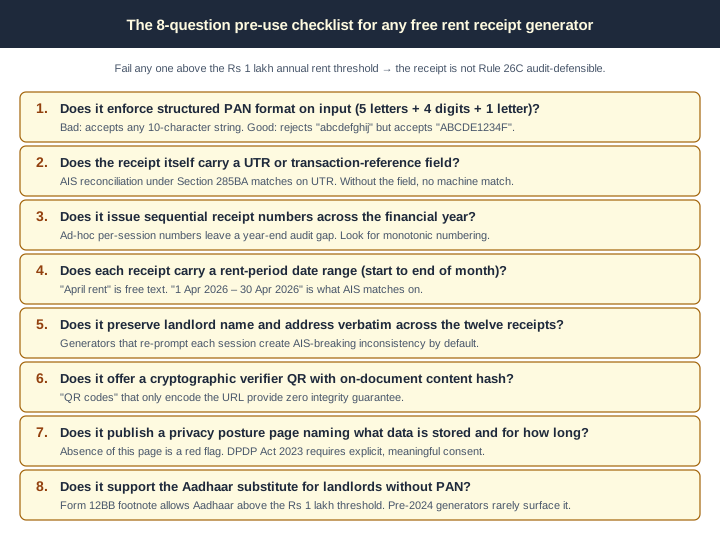
Eight questions. If a generator fails any one above the Rs 1 lakh threshold, the receipt it produces is not Rule 26C audit-defensible.
Run each question against the tool before submitting the receipt to your employer.
- Does the generator enforce structured PAN format (5 letters + 4 digits + 1 letter), or does it accept arbitrary input?
- Does it surface a UTR or transaction-reference field on the receipt itself, not just as an optional add-on?
- Does it produce sequential receipt numbers across the financial year, or ad-hoc numbers per session?
- Does it carry a rent-period date range (start date through end date of the month), or a free-text "April rent" field?
- Does it preserve landlord name and address verbatim across the twelve monthly receipts in a tenancy?
- Does it offer a cryptographic verifier QR with on-document content hash?
- Does it publish a privacy posture page naming what data is stored, for how long, and under what consent?
- Does it support the Aadhaar substitute path under the Form 12BB footnote for landlords without PAN?
Primary sources
- Rule 26C, Income Tax Rules 1962 — Landlord PAN required when aggregate annual rent exceeds Rs 1 lakh.
- Section 192(2D), Income Tax Act 1961 — Employer duty to obtain evidence of HRA deduction claims.
- Form 12BB (Rule 26C statement) PDF — Form fields include PAN or Aadhaar of landlord above Rs 1 lakh.
- Form 124 (Form 12BB successor, effective 2026-04-01) — New Income Tax Rules 2026 form rename.
- Section 285BA, Income Tax Act 1961 — AIS reporting basis. Rent line expansion from FY 2025-26.
- Section 139A, Income Tax Act 1961 — PAN format authority: 5 letters + 4 digits + 1 letter.
- Information Technology Act 2000, Section 4 — Electronic records carry equal legal validity to paper.
- Information Technology Act 2000, Section 5 — Digital signatures equivalent to wet signatures.
- Digital Personal Data Protection Act 2023 — Consent and processing standards for personal financial data.
- CBDT Circular No. 8/2013 — Plain-paper landlord declaration path when no PAN.
- PAN 2.0 / e-PAN portal — Instant Aadhaar-linked e-PAN issuance, live since 1 July 2025.
- Business Standard, Fake HRA enforcement (2024) — CBDT FY 2020-21 mass-notice cycle context.
Tools and generators
No signup. No email. Your data never leaves your browser.